How to Pick the Right Travel Mouse in 2026
Most people don’t choose a travel mouse in 2026 so much as inherit one. They grab whatever’s cheapest at the airport kiosk, or they just tough it out with the laptop trackpad for two weeks and quietly develop a sore wrist by day four. Neither is a real decision — and both cost more than the $20-$80 a good portable mouse actually runs. The mistake isn’t overspending. It’s picking based on size alone and ignoring the three things that determine whether the mouse survives a trip: how it powers on, how it connects, and whether it disappears into a bag without you thinking about it again.
DecodeGear is reader-supported. We may earn a small commission if you buy through our links — at no extra cost to you.
You’ll learn the five criteria that actually separate a good travel mouse in 2026 from a bad one, and we’ll use Logitech’s Mobi Fold — a genuinely new hinge-based format that launched June 10, 2026 — as a working example of how those criteria play out in a real product.
The Real Problem With Packing a Mouse for Travel
A full-size desktop mouse is comfortable but bulky — it eats bag space and looks silly next to a 13-inch laptop. A trackpad is always available but forces your fingers into repetitive, small-range motion that adds up over a travel day of spreadsheets, email, and slide decks. Logitech’s own engineering claim on the Mobi Fold is that switching from a trackpad to a dedicated mouse cuts muscle strain by roughly 22% — which tracks with what ergonomics research on pointing devices has said for years: trackpads ask more of your fingers, a mouse lets your whole hand and forearm share the work.
So the honest goal isn’t “smallest possible mouse.” It’s a mouse small enough to disappear in transit but still shaped like a mouse once it’s on the tray table or hotel desk.
Five Things That Actually Matter When You’re Buying One
Folded footprint, not just weight. A mouse that weighs 70 grams but is still shaped like a brick doesn’t pack any better than one that weighs 90. What matters is the volume it occupies folded flat in a laptop sleeve. This is the one spec where a hinge-based design has a real structural advantage over a mouse that’s simply “small” — a fixed-shape compact mouse can only get so thin before it stops being usable when unfolded.
Battery life measured in charge speed, not just total hours. Total battery life sounds impressive on a spec sheet, but for a traveler the number that matters is how fast it recovers from a dead battery in an airport lounge with 15 minutes before boarding. A mouse rated for 70 days on a full charge is great until it dies on day 71 with no outlet in sight.
Bluetooth versus a USB receiver. Bluetooth saves a USB-C port — increasingly precious on modern ultrabooks with two ports total — but it means pairing screens and occasional reconnect lag. A dedicated receiver (like Logitech’s Logi Bolt) is more consistent but is also a small object that’s trivially easy to lose in a bag. If you regularly switch between a laptop, a tablet, and a desktop, multi-device Bluetooth pairing (ideally three devices, swapped with one click) matters more than raw connection stability.
Sensor performance on real surfaces. DPI numbers get thrown around a lot, but for everyday productivity work, anything from 1,000 to 4,000 DPI is functionally identical — you won’t notice the difference in a browser or a spreadsheet. What you will notice is whether the sensor tracks reliably on the surfaces travelers actually use: glass conference tables, glossy hotel desks, the fabric arm of an airplane seat. That’s a sensor-quality question, not a DPI-number question.
Ergonomics when it’s compact. Any mouse smaller than a full-size desktop model asks more of your wrist and less of your forearm. That’s an acceptable trade-off for a two-hour flight or a coffee-shop work session; it becomes a problem in an eight-hour workday. Match the mouse’s size to how long you’ll actually be using it away from your main setup, not to how impressive it looks folded up.
Why the Foldable Format Is a Genuine Shift
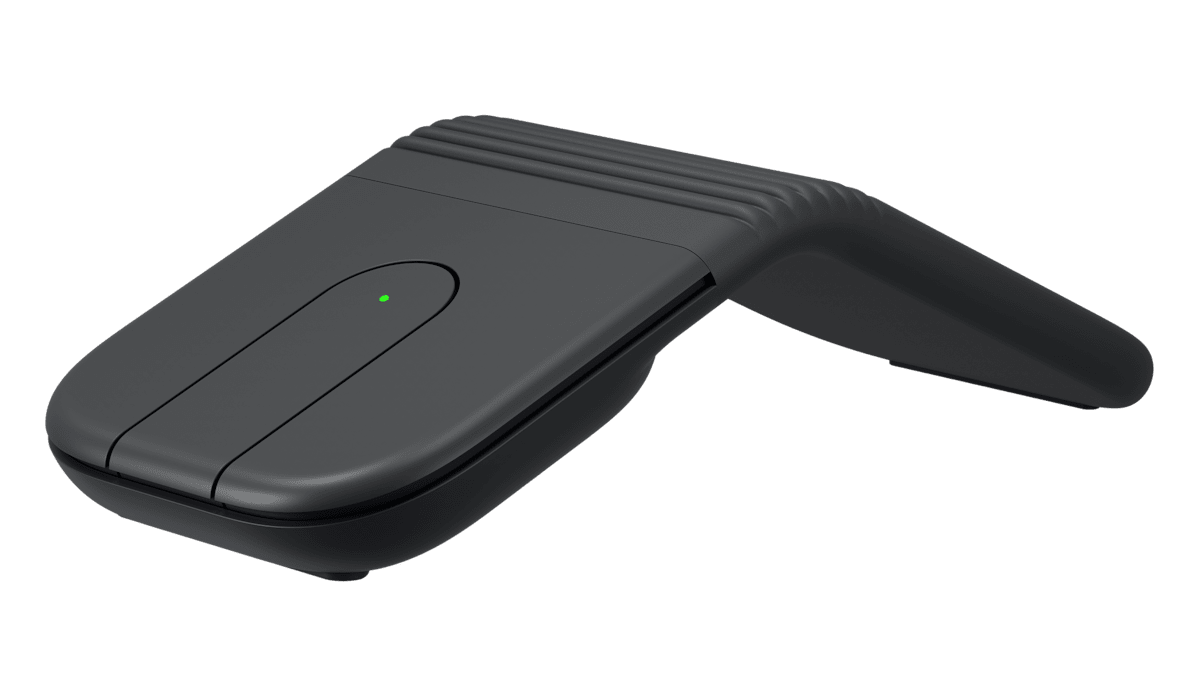
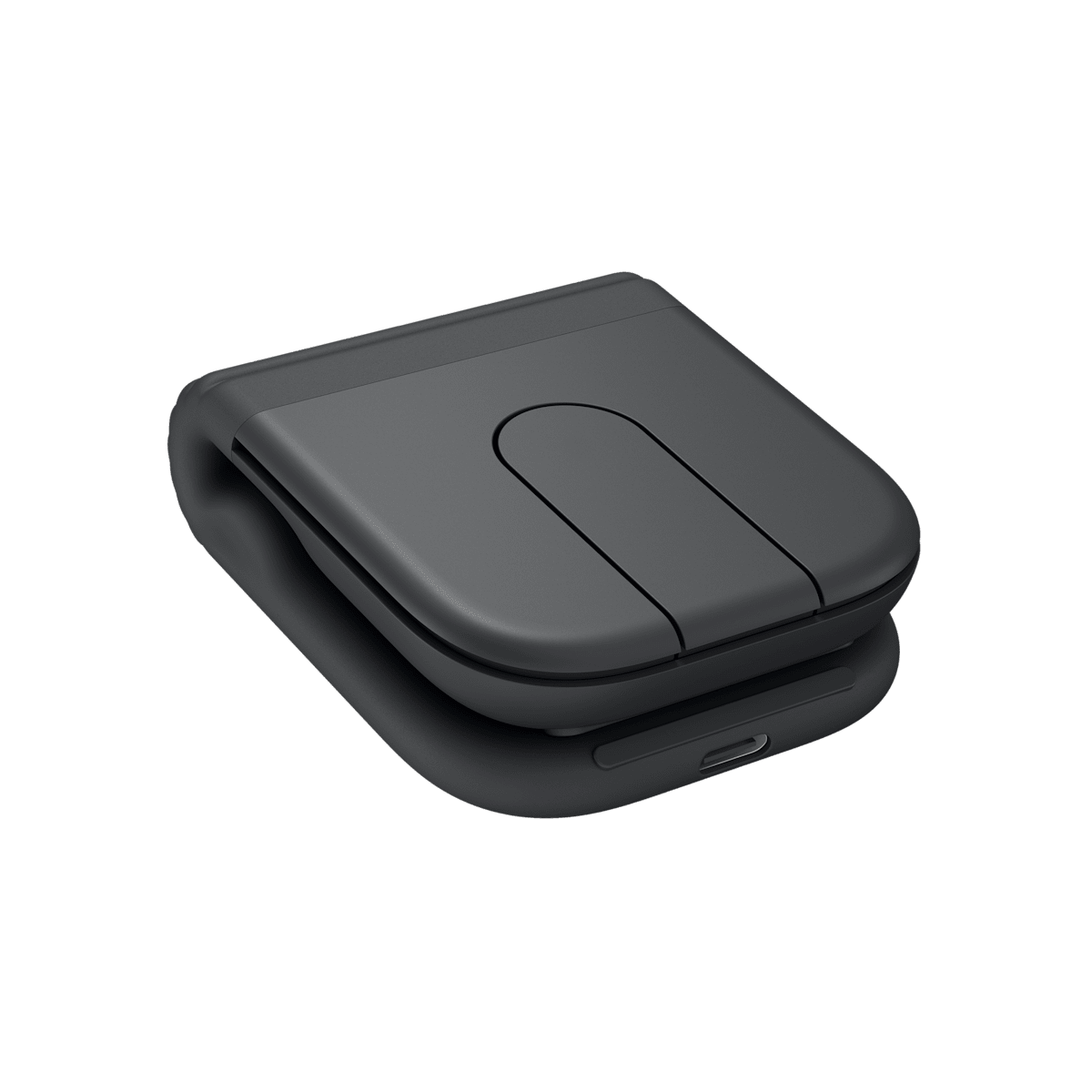
Logitech’s Mobi Fold, announced June 10, 2026, is the company’s first mouse built around a clamshell hinge rather than a fixed compact shape — and it’s a useful case study because it attacks the footprint problem directly instead of just shrinking a normal mouse. Folded, it collapses to roughly 66mm by 21mm — about the size of a stick of gum. Unfolded for use, it opens to a more standard 122mm by 33mm shape and weighs 79 grams, according to Logitech’s own listing and early hands-on coverage from 9to5toys and Techlicious.
The power mechanism is the clever part: opening the hinge turns the mouse on, and folding it shut turns it off — so there’s no power switch to forget and no battery draining quietly in a bag for two weeks. According to Logitech’s official product listing, the internal 100mAh battery is rated for up to 30 days of typical use on a full charge, and a 1-minute USB-C top-up buys about 22 hours — genuinely useful math for the “15 minutes at the gate” scenario above. Connectivity is Bluetooth Low Energy, pairing with up to three devices, and the Mobi Fold is the first Logitech product certified for Google Fast Pair. There’s no scroll wheel; instead, a touch-sensitive strip between the two buttons handles vertical scrolling, which Logitech calls Adaptive Touch Scroll.
It ships at $79.99 in Graphite, with Off-White, Lilac, and Sand available in select markets. A $89.99 Business version swaps in a Logi Bolt USB-C receiver for more secure pairing and doubles the warranty to two years — worth the $10 premium if your employer’s IT policy is stricter about Bluetooth peripherals, or if you’d rather not deal with pairing screens at all.
Notably, Logitech isn’t publishing a DPI figure for the Mobi Fold, and neither TechPowerUp nor the official press materials list one — a sign this is positioned as a productivity travel companion, not a precision tool. That’s consistent with the rest of the spec sheet: this is a mouse built to solve the packing problem, not to compete with a gaming mouse on sensor specs.
How It Stacks Up Against Other Travel Mice in 2026
| Mouse | Weight | Battery | Connectivity | Price | Best for |
|---|---|---|---|---|---|
| Logitech Mobi Fold | 79g | ~30 days; 1 min charge = 22h | Bluetooth (3 devices) | $79.99 | Smallest packed footprint |
| Logitech MX Anywhere 3S | 99g | 70 days; 1 min charge = 3h | Bluetooth + Logi Bolt receiver | ~$99 | Glass/glossy surfaces, 8K DPI sensor |
| Apple Magic Mouse | ~99g | Weeks per charge | Bluetooth | $79-99 | Apple-only ecosystems |
| Logitech Pebble 2 M350s | Ultra-light | Up to 18 months (1 AA) | Bluetooth/USB receiver | ~$25 | Budget backup mouse |
The MX Anywhere 3S remains the stronger pick if you spend a lot of time working from glass desks or glossy cafe tables — its Darkfield sensor is built for exactly that, and 70 days between charges is hard to beat. But it doesn’t fold, so it still occupies a fixed chunk of bag space. The Mobi Fold trades some of that raw battery runtime and sensor sophistication for a footprint no traditional compact mouse can match.
Pro tip: the fold-to-power-off habit matters more than it sounds
The detail most buying guides skip is the power mechanism itself. A mouse you have to remember to switch off will eventually die in your bag between trips — and dead-on-arrival is the single most common travel mouse complaint in user reviews across every brand. A design where closing it is the off switch removes that failure mode entirely. If you’re comparing two otherwise similar mice, weight the one with fold-to-off or a similarly automatic power state higher than the spec sheet suggests you should.
If you’re building out a full setup rather than just a travel bag, our guide to building the perfect WFH desk covers how a travel mouse fits into a larger remote-work kit without duplicating gear you already own. And if raw productivity power matters more to you than folding down small, our Logitech MX Master 3S review breaks down the case for a larger, more feature-rich mouse that still travels reasonably well.
Want to see current pricing and color availability on the Mobi Fold? 🛒 Check Mobi Fold prices on Amazon
Frequently Asked Questions
Is a foldable mouse actually durable?
Logitech rates the Mobi Fold’s hinge for 15 years of daily folding and covers it with a dust-resistant silicone sleeve, according to the company’s press materials. That’s a strong claim for a first-generation product, though independent long-term durability testing hasn’t had time to accumulate since the June 2026 launch — treat it as a manufacturer claim worth revisiting in a year.
Do I need the Business version with the USB receiver?
Only if your workplace restricts Bluetooth peripherals or you specifically want the more consistent pairing a dedicated Logi Bolt receiver provides. For most personal travel use, the standard $79.99 Bluetooth-only version is simpler and one less small object to lose.
What’s the real difference between a travel mouse and a regular compact mouse?
A “compact” mouse is just a smaller fixed shape — good for portability, but limited by how thin it can get before it’s uncomfortable to grip. A folding mouse like the Mobi Fold sidesteps that trade-off: it’s full-size-ish when open and dramatically smaller when closed, because the shape itself changes rather than just shrinking.
Does DPI matter for a travel mouse?
Not much, for typical productivity use. Anything in the 1,000-4,000 DPI range handles browsing, email, and spreadsheets without any perceptible difference. It matters more for gaming or precision design work — use cases a travel mouse usually isn’t built for anyway.
The Bottom Line
Picking a travel mouse comes down to matching the format to how you actually travel. If your trips are short and your bag space is at a premium, a folding design like the Mobi Fold solves a packing problem no compact mouse has solved before. If you’re regularly parked at glass desks or need maximum battery runway between charges, a mouse like the MX Anywhere 3S is still the safer bet. Either way, judge the mouse on footprint, charge speed, and connectivity flexibility first — the spec sheet numbers that actually change how a trip feels — and treat DPI and brand names as the tiebreakers they really are.
Deixe um comentário