Disclosure: DecodeGear is reader-supported. We may earn a commission if you buy through links in this article, at no extra cost to you. We compare verified specs, live pricing, and aggregated buyer ratings — we don’t accept paid reviews.
AR glasses have spent the last three years overpromising and underdelivering — clunky headsets, washed-out displays, and price tags that only made sense for early adopters. The RayNeo Air 4 Pro is TCL’s latest attempt to close that gap at $299, and on paper it reads like a proper leap: a 201-inch virtual display, HDR10, and a chip built specifically to make streamed video look sharper than the hardware has any right to. We compared the spec sheet against verified Amazon.com pricing and buyer ratings to see whether it actually holds up outside a demo booth.
Best for: Frequent flyers, dorm/small-space movie watching, gaming on the go with a Switch 2 or Steam Deck
What the RayNeo Air 4 Pro Actually Is
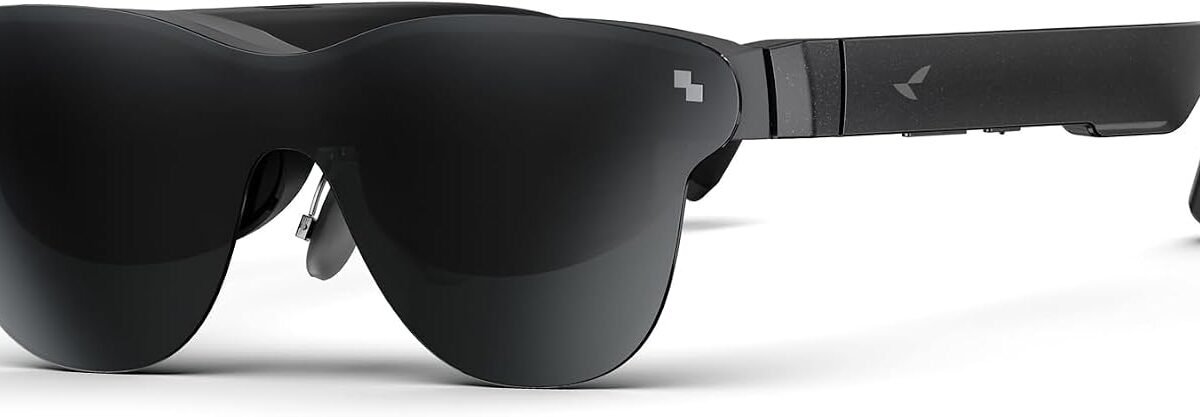
The Air 4 Pro isn’t a mixed-reality headset like the Vision Pro or an AI assistant like Meta’s Ray-Bans — it’s a wearable display. Plug it into a USB-C source (a phone, a laptop, a Switch 2, a Steam Deck, a PS5) and it projects what’s essentially a private 201-inch HDR10 screen in front of your eyes, with no external speakers or cables needed for audio. There’s no positional tracking and no battery inside the glasses themselves; they draw power and video signal entirely through the USB-C cable, which keeps them light — TCL lists the frame at 76 grams — but also means they’re a companion accessory, not a standalone device.
Quick Verdict
| Spec | RayNeo Air 4 Pro |
|---|---|
| Price | $299 |
| Display | 201″ virtual screen, HDR10, 120Hz |
| Chip | Vision 4000 (AI SDR-to-HDR upscaling, co-developed with Pixelworks) |
| Audio | Quad-speaker, tuned by Bang & Olufsen, 360° soundstage |
| Weight | 76g |
| Rating | 3.9/5 (126 ratings, Amazon.com) |
Display and Specs — The 201-Inch Screen in Your Pocket
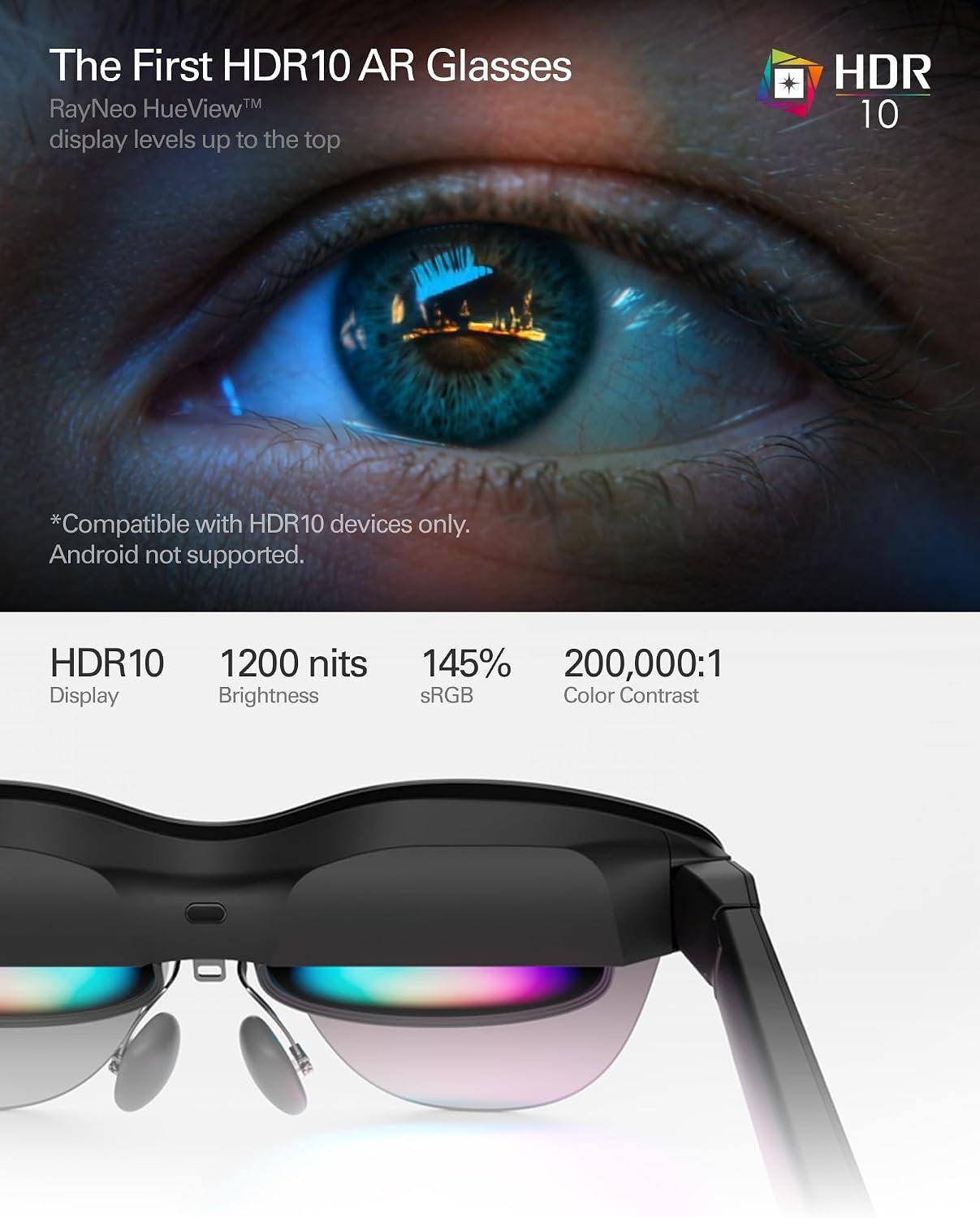
The headline feature is the Vision 4000 chip, which handles real-time AI upscaling from standard-dynamic-range source video to HDR — useful because most of what people actually watch (streamed shows, YouTube, screen-mirrored apps) isn’t mastered in HDR to begin with. TCL says the chip was co-developed with Pixelworks specifically for that conversion, rather than just slapping an “HDR10” sticker on a panel that can’t really use it. The display itself is rated at 120Hz, which matters more for gaming than movies — it’s the reason RayNeo lists Switch 2, PS5, and Steam Deck compatibility directly on the product page instead of treating gaming as an afterthought.
Build quality leans toward eye comfort over gimmicks: TÜV SÜD low blue-light certification and a 3840Hz flicker-free display are both aimed at the actual complaint people have with wearable screens — eye strain after 30+ minutes. That’s a more useful spec than raw brightness numbers, since these are glasses meant to be worn for a two-hour flight, not a five-minute demo. Full spec details, including the color accuracy claims, are on RayNeo’s official product page.
One detail that’s easy to miss in the marketing copy: the frame has a magnetic mount built for prescription lens inserts, supporting up to -1000 degrees of myopia, +800 degrees of hyperopia, and 200 degrees of astigmatism correction. That’s not a niche accessibility footnote — it’s the difference between glasses-wearers being able to actually use these day-to-day versus needing to squeeze them over their existing glasses, which is still how some competing AR glasses expect you to wear them.
Comfort and Everyday Use
At 76 grams, the Air 4 Pro is light enough that reviewers consistently describe it as wearable for a full movie without the nose-bridge fatigue that killed earlier AR glasses generations. The audio is arguably the bigger surprise: a quad-speaker array tuned with Bang & Olufsen aims for a 360-degree soundstage without leaking much sound to people sitting next to you — a real consideration if you’re planning to use these on a plane or in a shared space. Setup is plug-and-play over USB-C, with no app pairing or Bluetooth handshake required, which matters when you’re trying to start a movie before takeoff, not debug a connection.
Where It Falls Short
The honest caveats: this is 3DoF, not 6DoF — the display tracks head rotation to keep the virtual screen anchored, but there’s no positional/spatial tracking of the kind full mixed-reality headsets offer, so don’t expect room-scale AR apps. There’s also no internal battery; power and signal both come from whatever you’ve plugged into, which means battery life is really a question about your phone or laptop, not the glasses. And at 3.9 out of 5 stars across 126 ratings, buyers aren’t universally sold — the most common friction points in that feedback are fit for narrower faces and the learning curve of finding the sweet spot where the virtual display sits perfectly in your field of view.
How It Compares — XREAL One and Rokid Glasses
The Air 4 Pro isn’t the only serious option in this price range. XREAL’s One lineup runs from roughly $449 to $599 and adds Sony micro-OLED panels most reviewers rate slightly sharper — worth the premium if display quality alone is your priority; we go deeper on that tier in our ROG XREAL R1 review. If you want the glasses to do more than play video — live translation and AI features layered on top of the display — that’s the pitch behind Rokid Glasses, which add live translation to the same basic wearable-display concept. The Air 4 Pro’s angle is simpler and cheaper: the best HDR video experience for $299, full stop, without paying for features you might not use.
If your use case is actually a fixed setup at a desk rather than something portable, it’s worth pointing out that a traditional gaming monitor will still beat any AR glasses on raw image quality and price-per-inch — the Air 4 Pro’s advantage is entirely about portability, not replacing a real screen at home.
Which One Should You Buy?
Buy the standard RayNeo Air 4 Pro at $299 if you want the best HDR movie/gaming experience you can wear on a plane or in a dorm room, and you don’t need spatial tracking or built-in AI features. TCL also sells a Batman Limited Edition variant with a collector-grade case and special lens shade — same core hardware, a novelty pick if you want a conversation piece rather than a plain black frame. Skip it if you were hoping for a full mixed-reality headset, or if your face shape runs narrower — check the return policy before committing, since fit is the most common complaint in verified reviews.
Check the Batman Limited Edition on Amazon →
Frequently Asked Questions
Are the RayNeo Air 4 Pro worth $299?
For what they’re designed to do — a portable HDR display for movies and gaming — yes. The Vision 4000 chip’s upscaling and the Bang & Olufsen-tuned audio outperform the price. They’re not worth it if you’re expecting full mixed-reality tracking, which these don’t offer.
Do the RayNeo Air 4 Pro work with the Nintendo Switch 2?
Yes. RayNeo lists Switch 2 compatibility directly, alongside PS5 and Steam Deck, via USB-C plug-and-play — no additional adapter needed for devices with USB-C video output.
How is the RayNeo Air 4 Pro different from XREAL glasses?
The Air 4 Pro is cheaper ($299 vs $449+) and focuses on HDR video/gaming. XREAL’s lineup generally uses sharper micro-OLED panels and sits in a higher price tier — the right pick if display sharpness matters more to you than price.
Do the glasses have their own battery?
No. They draw power and video signal through the USB-C connection to your phone, laptop, or console, so there’s no separate battery to charge or manage.
Leave a Reply