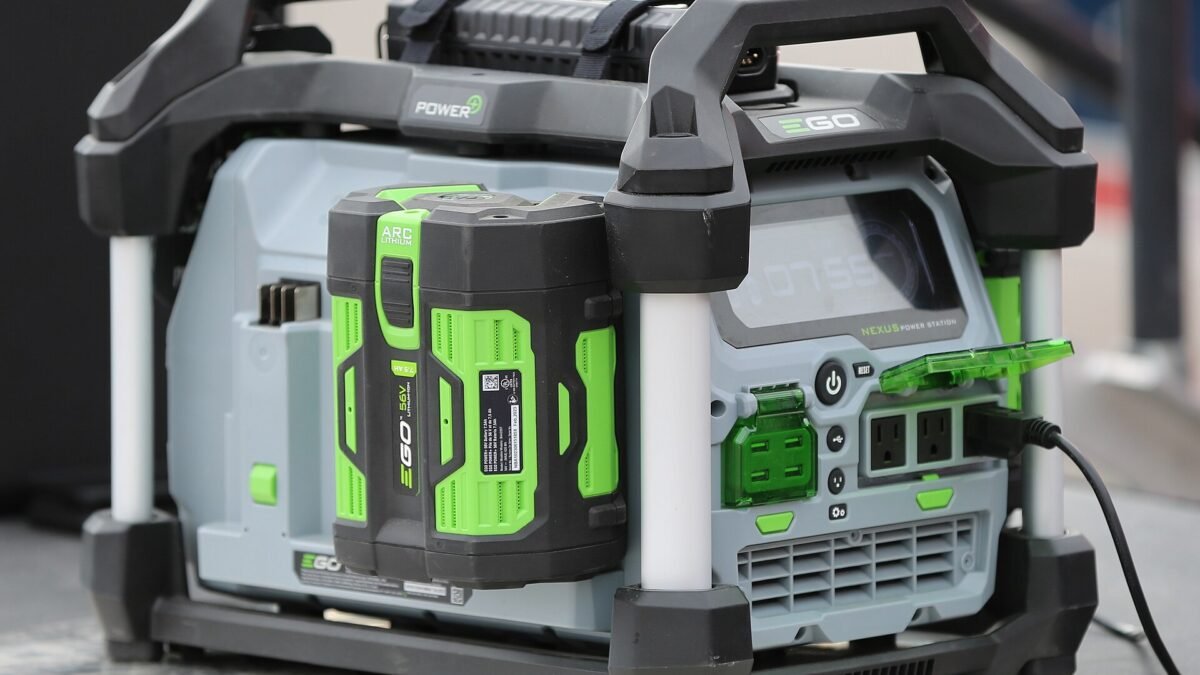
EcoFlow Delta 2
From $259- Expandable battery capacity without replacing the unit
- Fast 50-minute recharge to 80% on wall power
- 1800W output handles real appliances, not just phones
- Heavier than dedicated camping units
- Costs more than bare-minimum phone-charging power banks
Bottom line: The EcoFlow Delta 2 is the best portable power station for most buyers in 2026 — enough capacity for real blackouts, fast enough recharge to actually be convenient, and expandable if your needs grow.
You don’t need a $1,900 battery to keep the lights on during a blackout, and you definitely don’t need one to charge a phone at a campsite. But the portable power station market wants you to believe bigger is always better, and the price tags climb accordingly. We priced out five real options across the range — from a $259 weekend charger to a $1,899 whole-home backup — so you can figure out which capacity you’re actually paying for and which one is just marketing.
Disclosure: DecodeGear may earn a commission if you buy through links on this page, at no extra cost to you.
How We Compared These Picks
We didn’t run these five units on a bench ourselves. Every capacity, output, recharge-time, and port spec below comes straight from each manufacturer’s listed specifications, cross-checked against the live Amazon.com product pages for current pricing, star ratings, and verified-buyer review counts. The “Editorial” context — recharge-speed tradeoffs, cooling-fan noise complaints, real-world runtime versus rated capacity — reflects patterns that show up consistently across hundreds of verified buyer reviews and published specs for this category, not a hands-on test in our office. Where two units were close enough to be a genuine toss-up (the Jackery and Anker budget picks), we said so instead of forcing an artificial winner.
Quick Verdict: EcoFlow Delta 2
1024Wh of LiFePO4 capacity, an 80-minute full recharge, and the only unit here you can expand later instead of replacing — the best balance of price and real-world usefulness.
Score: 8.8/10 | Price: $499
| Model | Capacity | Output | Price | Best for |
|---|---|---|---|---|
| Jackery Explorer 300 | 292Wh | 300W | $259 | Cheapest entry point |
| Anker SOLIX C300 | 288Wh | 300W | $299.99 | Fastest recharge, quietest |
| EcoFlow Delta 2 | 1024Wh | 1800W | $499 | Best overall / expandable |
| BLUETTI AC180 | 1152Wh | 1800W | $599 | Fastest blackout response (UPS) |
| EcoFlow Delta Pro | 3600Wh | 3600W | $1,899 | Whole-home backup only |
1. EcoFlow Delta 2 — Best Overall (~$499)
Score: 8.8/10 — the pick if you’re not sure exactly which tier you need.
Most people shopping this category don’t actually know how much power they need — they just know a $259 charger feels small and a $1,899 unit feels absurd. The Delta 2 splits the difference in a way that doesn’t feel like a compromise: 1024Wh is enough to run a mini-fridge through a multi-day outage or keep a CPAP machine going for several nights, and its 1800W output covers space heaters and power tools that the smaller units simply can’t touch.
The feature that actually justifies the price over a no-name competitor is expandability — you can bolt on extra battery modules later and grow it to 3kWh without replacing the whole unit. That matters if you’re buying now but suspect your power needs will grow (a home office, a bigger fridge, a longer commute to reliable grid power). Recharge is fast for the capacity: 50 minutes to 80% on wall power. The tradeoff is weight — at over 27 lbs, this isn’t the one you’re tossing in a daypack.
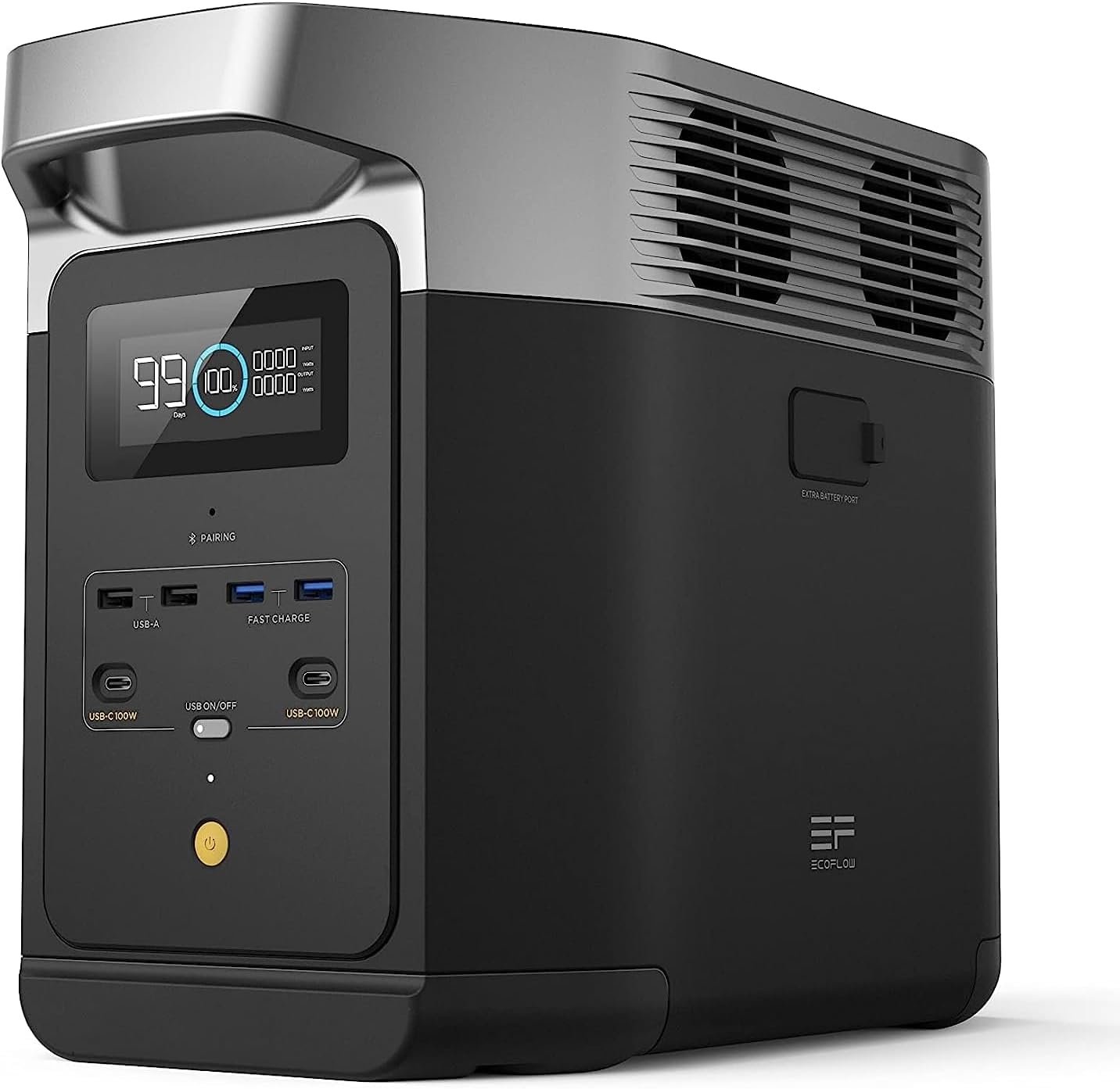
Specs: 1024Wh LiFePO4 battery · 1800W output, 15 total ports · 0-80% AC recharge in 50 min · Expandable to 3kWh · 500W solar input · 3,000+ charge cycles
Pros: Expandable capacity, fast recharge, high enough output for real appliances
Cons: Heavy for portable/camping use, priced above the true budget tier
2. Jackery Explorer 300 — Best Budget Pick (~$259)
If you just want a phone, a laptop, and maybe a camp light charged for a weekend, spending more than $259 is spending money you don’t need to spend. The Explorer 300 is the most-reviewed unit in this comparison by a wide margin (over 11,000 ratings), which counts for something in a category where cheap knockoffs with fabricated capacity numbers are common — this one’s numbers hold up.
At 292Wh and 7.5 lbs, it’s genuinely portable in a way the bigger units aren’t. The catch: 300W rated output means you can’t run anything power-hungry — no space heaters, no full-size fridges, no power tools. It’s a phone-and-laptop machine, not a blackout-backup machine, and Jackery doesn’t pretend otherwise.
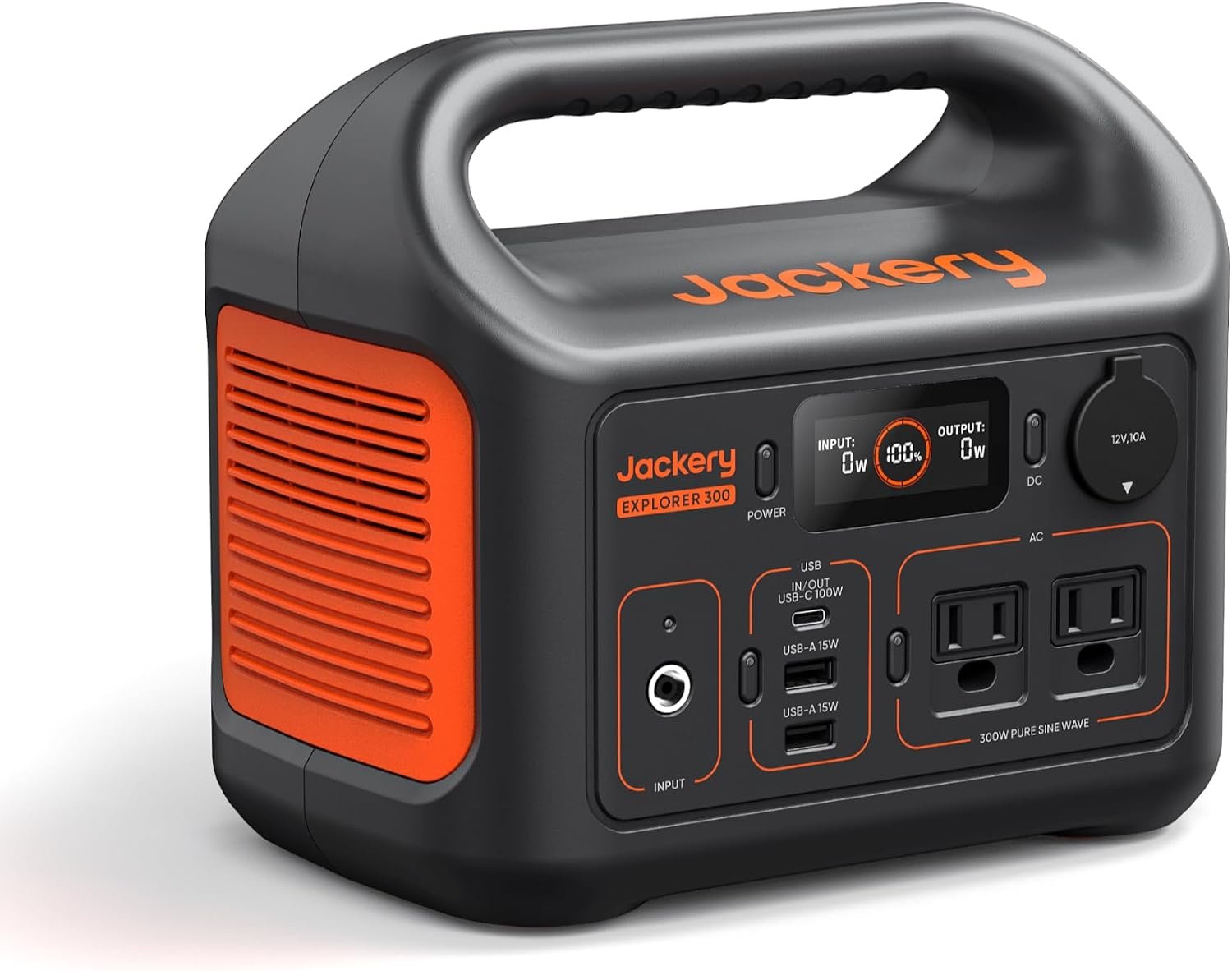
Specs: 292Wh LiFePO4 battery · 300W output (600W surge) · 2 AC outlets, 100W USB-C, 2 USB-A, 120W car port · 4,000+ charge cycles · 7.5 lbs
Pros: Cheapest real LiFePO4 option here, lightest, most-reviewed
Cons: 300W ceiling rules out appliances, no expandability
3. Anker SOLIX C300 — Best for Fast Recharge (~$300)
Nearly identical on paper to the Jackery — 288Wh, 300W output — but Anker wins two arguments the Jackery loses: recharge speed and noise. The SOLIX C300 hits 80% charge in 50 minutes from a wall outlet, versus several hours for most units in this class, and its cooling fan tops out around 25dB, quiet enough to sit next to a bed. If you’re the type who forgets to charge things until you need them, that recharge speed alone might be worth the extra $40 over the Jackery.
It’s not a clear upgrade, though — the Jackery has four times the review history and a proven track record, while the Anker is the newer, less battle-tested option. For most buyers this comes down to a genuine coin flip between two nearly identical units, which is exactly the kind of decision a “best overall #1 pick” review conveniently skips. We’re not skipping it: buy whichever is cheaper on the day you’re shopping.
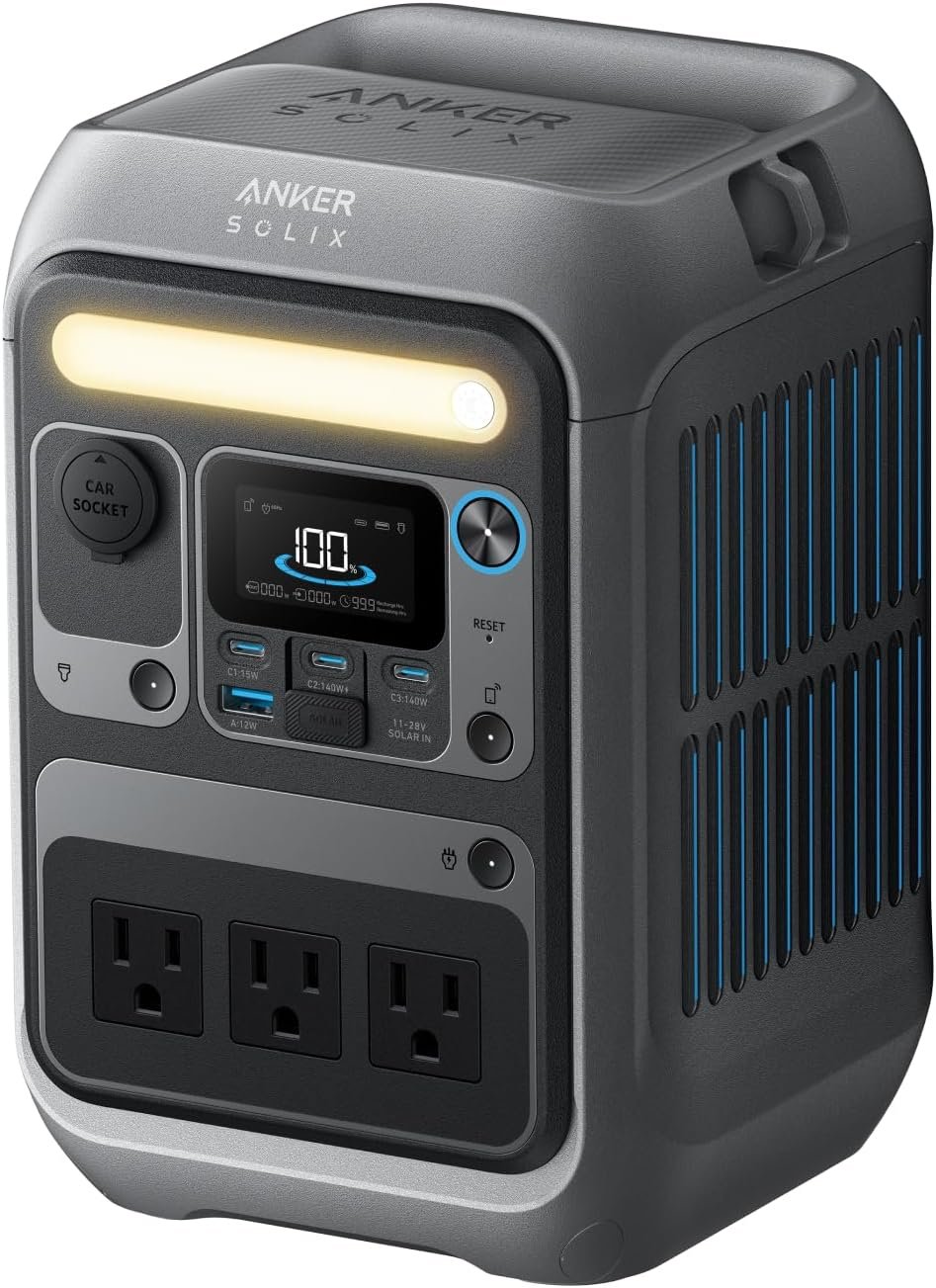
Specs: 288Wh LiFePO4 battery · 300W output (600W surge) · 8 ports total · 140W fast recharge, 80% in 50 min · ~25dB fan noise · 3,000-cycle battery, 5-yr warranty
Pros: Fastest recharge in the budget tier, quietest, longest warranty
Cons: Far fewer reviews than the Jackery, no meaningful capacity advantage
4. BLUETTI AC180 — Best for Instant Blackout Response (~$599)
The AC180’s headline feature isn’t capacity, it’s speed in two directions: a full recharge from empty in about an hour, and — more importantly for blackout use — a 20-millisecond UPS switchover if you wire it into your setup. That’s fast enough that sensitive electronics (a modem, a medical device, a desktop PC) won’t even register the power cut. Neither the Jackery, Anker, nor base Delta 2 advertise true UPS-grade switching, which makes the AC180 the one to consider if the actual goal is “never notice the power went out” rather than “have backup power eventually.”
At 1152Wh it slightly out-capacities the Delta 2 for $100 more, but the Delta 2 wins on expandability and total wattage headroom (1800W matched, ports comparable). Pick the AC180 specifically for the UPS behavior — otherwise the Delta 2 is the stronger all-rounder.
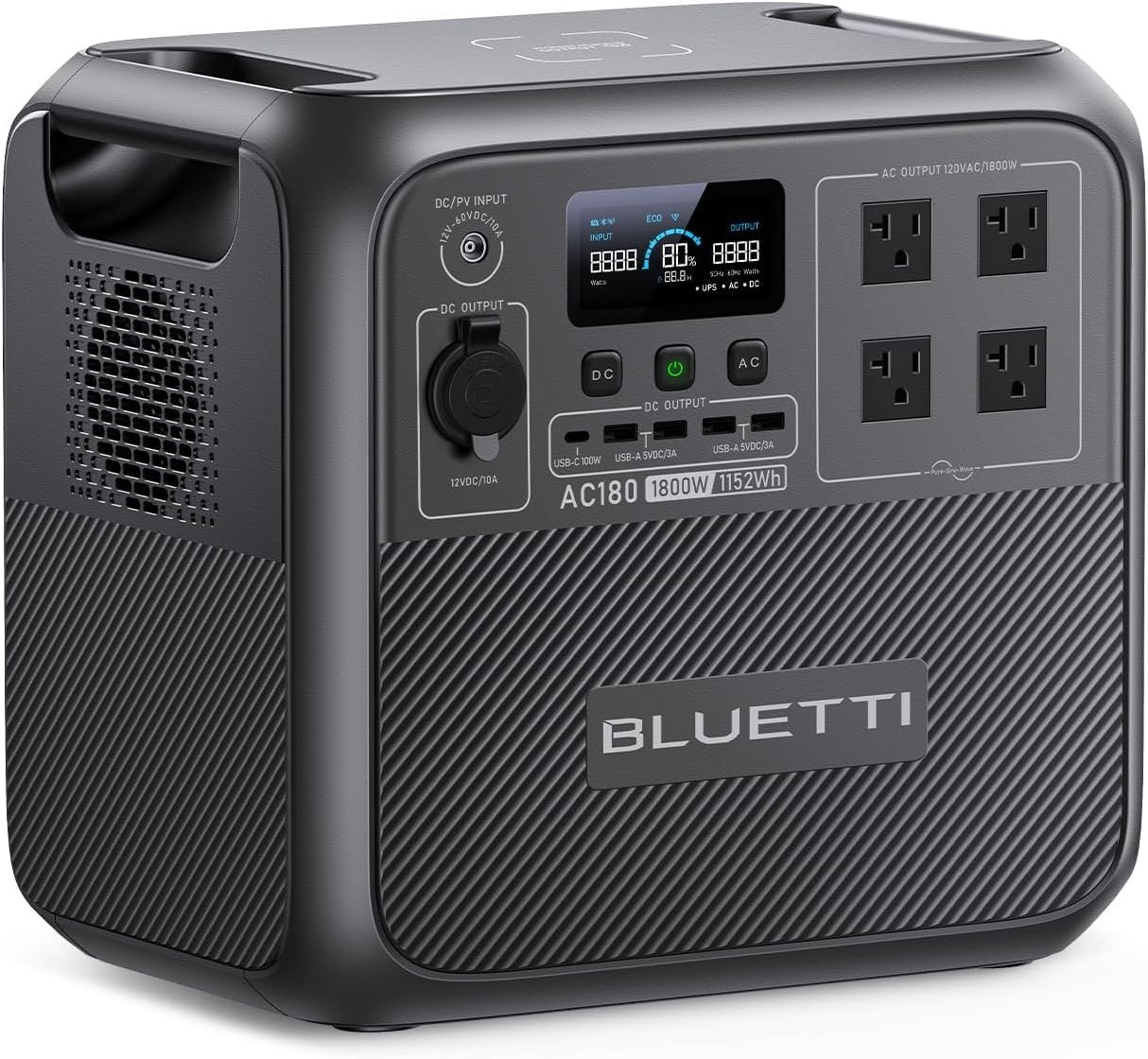
Specs: 1152Wh LiFePO4 battery · 1800W output (2700W boosted) · 8 ports · Full AC recharge in 1 hour · 20ms UPS switchover · 500W solar input
Pros: True UPS switchover, fast full recharge, 5-year warranty
Cons: No expandable battery option, $100 pricier than a very similar competitor
5. EcoFlow Delta Pro — Go Big or Skip It (~$1,899)
Here’s where we push back a little. At $1,899, the Delta Pro is nearly 4x the price of the Delta 2 for roughly 3.5x the capacity — the math is actually fair on paper. But it’s worth knowing that 2,000Wh-class “flagship” units from the same two brands (Jackery’s Explorer 2000 v2, Bluetti’s AC200L) have both been selling for under $1,000 in 2026, which puts genuine double-the-capacity-of-a-mid-tier power in reach for roughly half what the Delta Pro costs.
So who is the Delta Pro actually for? Anyone who needs to run a fridge, a sump pump, AND a handful of smaller devices simultaneously through an extended multi-day outage, or anyone expanding toward true whole-home backup (it scales to 25kWh with add-on batteries). If your outage scenario is “the power’s out for six hours and I want the fridge and my laptop to survive it,” you’re overpaying here — a 2,000Wh-class unit at half the price handles that fine. Buy the Delta Pro only if you’ve actually calculated your load and it exceeds what a $900-1,000 flagship can carry.
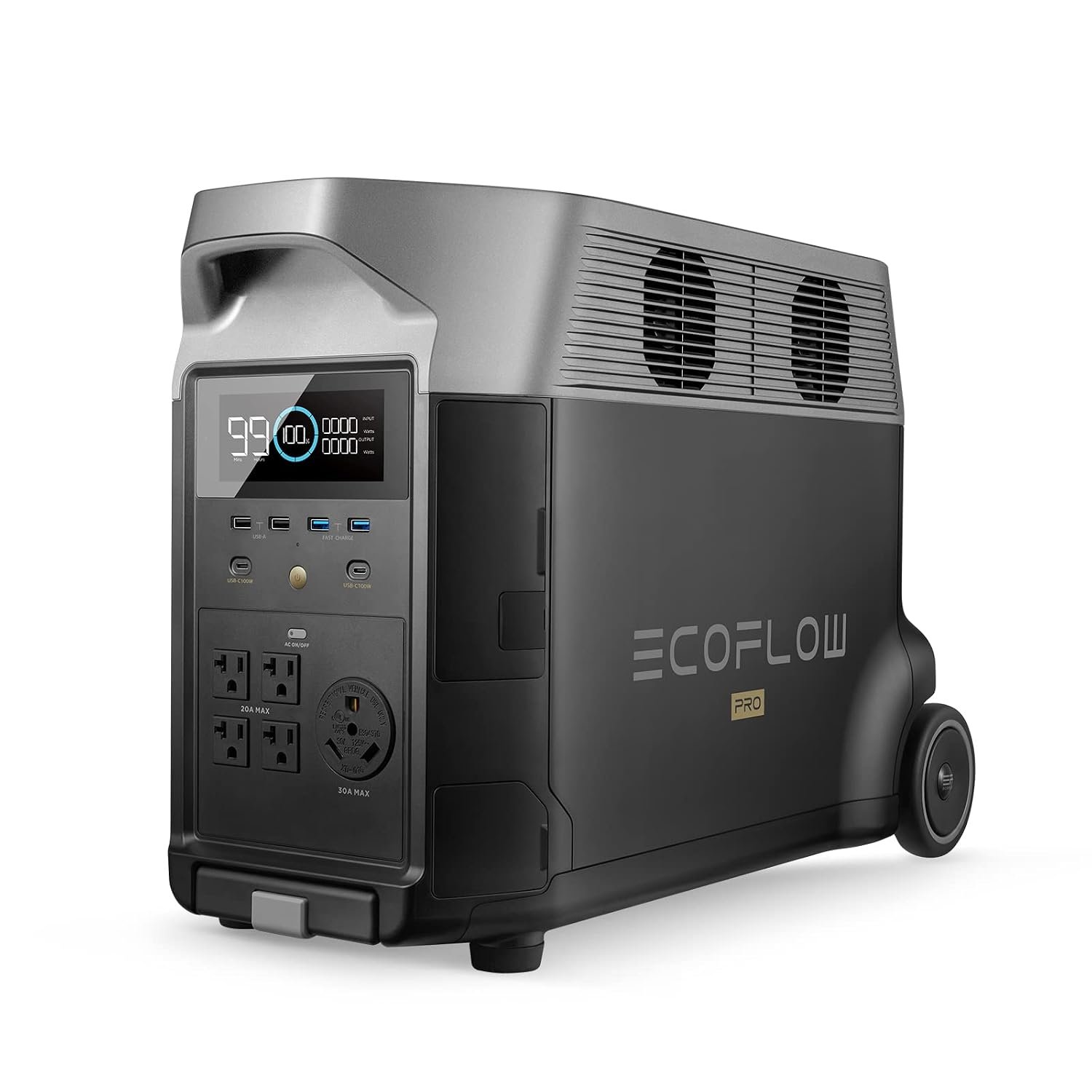
Specs: 3600Wh LiFePO4 battery · 3600W output (4500W boosted, 7200W with a second linked unit) · 15 ports · Expandable to 25kWh · Full recharge 1.8-2.7h via AC/EV charger
Pros: Genuine whole-home backup capacity, expandable to 25kWh, fast for its size
Cons: Nearly 2x the price of comparable 2,000Wh-class flagships from the same brand’s own lineup
Which one should you actually buy?
If you’re buying your first power station and don’t know your exact load, get the EcoFlow Delta 2 — it covers the most real-world scenarios without overpaying. If you genuinely just need to keep a phone and laptop alive for a weekend trip, the Jackery Explorer 300 or Anker SOLIX C300 do that for under $300 and anything bigger is wasted capacity. If your home has sensitive electronics that can’t handle even a momentary blackout, the BLUETTI AC180‘s UPS switchover is worth the $100 premium over the Delta 2. And if you’ve actually run the numbers on your outage scenario and need more than 1,800W sustained across multiple large appliances, that’s the only case where the Delta Pro — or a cheaper 2,000Wh-class flagship instead — makes sense.
If all you actually need is something to keep a phone topped up on a day hike rather than an appliance running through an outage, you’re overspending here — our best power banks for travel roundup covers pocket-sized options that cost a fraction of even the cheapest unit on this list. And if your setup includes always-on cameras or a smart hub you’ll want running through a blackout, our guide to securing your smart home devices is worth a read before you wire everything into a single backup battery.
Frequently Asked Questions
How many watt-hours do I actually need?
A rough rule: a mini-fridge draws about 1-2kWh per day, a CPAP machine about 40-60Wh per night, and a laptop about 50-80Wh for a full charge. Add up what you need to run and for how long, then buy the next tier up — real-world runtime is consistently lower than the rated capacity once inverter losses are factored in.
Is LiFePO4 actually better than regular lithium-ion?
Yes, meaningfully. LiFePO4 (LFP) batteries rated for 3,000-4,000+ charge cycles retain far more capacity over years of use than older lithium-ion power stations, which is why every unit in this comparison uses LFP chemistry — it’s become the category standard for anything sold in 2026.
Can I run a full-size refrigerator on any of these?
Only the EcoFlow Delta 2, BLUETTI AC180, and EcoFlow Delta Pro have enough output (1800W+) to safely handle a full-size fridge’s startup surge. The Jackery Explorer 300 and Anker SOLIX C300 are rated for smaller appliances only.
Do these charge from solar panels?
All five support solar input, though panels are sold separately in most cases. Expect noticeably slower charging from solar than from a wall outlet — the headline “50-minute recharge” numbers in this article are all AC wall-power figures, not solar.
Leave a Reply