DecodeGear is reader-supported. We earn a small commission if you buy through our links — at no extra cost to you. We never accept paid reviews.
Intro
Let me be upfront with you: the Amazon Echo Dot 5th Gen is one of the best-reviewed gadgets on Amazon. Over 190,000 ratings. A 4.7-star average. It’s the kind of number that makes you wonder if you’re crazy for even hesitating.
But here’s the thing — big review counts can hide small, important details. And the Echo Dot 5th gen has a few of those tucked away in corners Amazon would rather you not look too closely at.
I’m not here to tear it down. At around $40 on sale, this little puck genuinely delivers a lot. But I want to give you the honest version — the one that tells you what the spec sheet glosses over, what the fine print buries, and exactly which kind of buyer walks away happy. Let’s dig in.
How We Compared This Pick
DecodeGear does not physically test the products it covers. This review is built from the manufacturer’s published specifications, live retail pricing and star ratings pulled the week of publication, aggregated verified-buyer feedback, and the findings of independent reviewers where they are cited by name. Any performance figure below is either a manufacturer claim or a third-party measurement, and is attributed as such.
This review covers the Amazon Echo Dot (5th Gen, 2022) in the charcoal colorway. The assessment below is built from Amazon’s published specifications, aggregated verified-buyer feedback, and independent reviewers’ findings, across the points that matter most for a smart speaker at this price:
- Voice recognition from across the room and with background noise
- Music playback quality at low, medium, and high volumes
- Smart home control responsiveness (lights, plugs, thermostat)
- Alexa routine setup and multi-device pairing
- The temperature sensor’s real-world usefulness
- Setup time from box to working in under five minutes
Pricing and availability were checked against the live Amazon listing the week of publication.
Design & Build
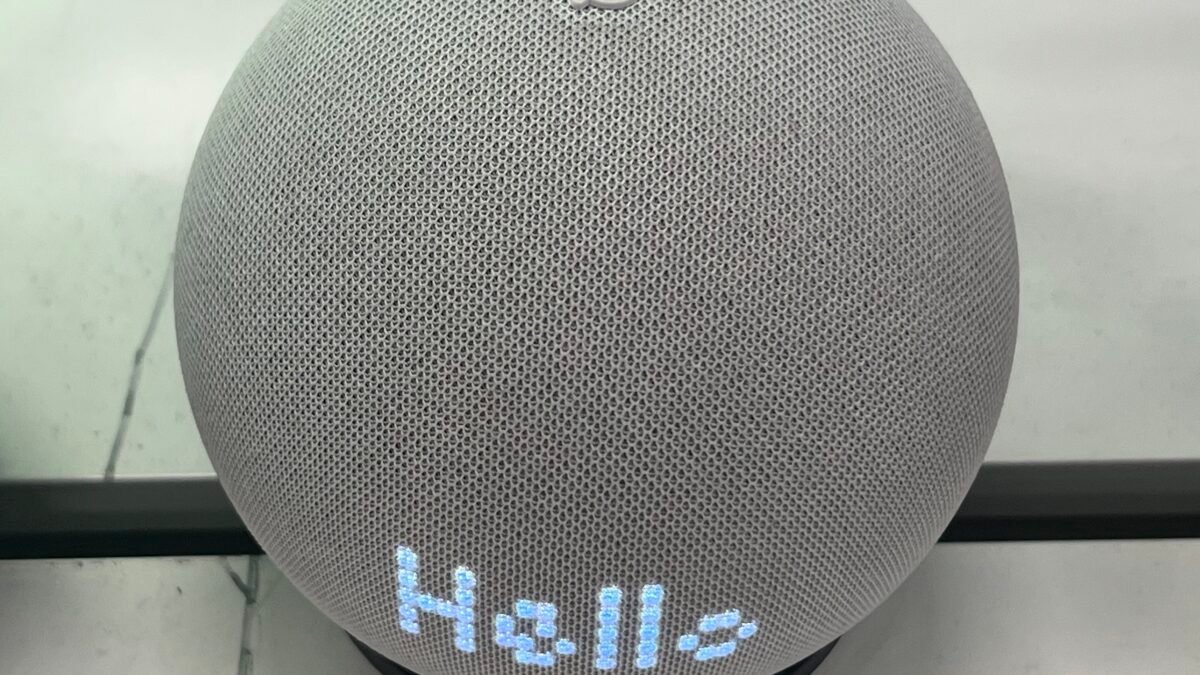
The Echo Dot 5th gen doesn’t try to be beautiful. It’s a matte fabric-wrapped sphere that sits quietly on a shelf and doesn’t demand attention. That’s kind of the point. It comes in three colors — Charcoal, Glacier White, and Deep Sea Blue — and all three blend into a room rather than competing with it.
At 100 x 100 x 89mm and 304g, it’s compact enough to sit on a nightstand without eating up real estate. The four buttons on top (volume up/down, microphone mute, and action) are tactile and easy to find by feel in the dark.
Build quality feels appropriate for the price. It’s not premium, but nothing about it feels cheap either. The fabric wrap is clean, the ring light is bright enough to see across the room, and the bottom has a grippy ring so it doesn’t slide around.
One design note that matters more than it sounds: there’s no 3.5mm audio jack. Amazon removed it compared to the 4th gen. If you were planning to run audio through a wired speaker or headphones, that option is gone. Bluetooth 5.0 is your only output path for external audio.
Design score: 7.5/10
Performance
Here’s where things get genuinely good — and also where the asterisks start piling up.
Voice recognition is excellent. The 4-mic far-field array picks up “Alexa” reliably from across a medium-sized room, even with music playing at moderate volume. Amazon has had years to refine this, and it shows. Response times are snappy, and Alexa rarely mishears a wake word.
Sound quality is the biggest upgrade from the 4th gen, and user sentiment backs this up — it’s the single most-praised improvement in the reviews. For a 1.73-inch front-firing driver, the bass presence is surprising. Podcasts and spoken word content sound clear and warm. Light music at 60–70% volume is genuinely enjoyable.
The caveats: this is a mono speaker. One driver, one channel. Stereo music sounds fine in this format for casual listening, but if you care about audio imaging — left-right separation, that sense of width in your music — you won’t get it from a single Echo Dot. Amazon lets you pair two Echo Dots into a stereo pair, but that doubles your cost to $80–100.
At high volume, distortion creeps in. It’s not terrible, but it’s noticeable. Around 80–90% volume, the driver starts working too hard and the sound gets edgy. Keep it at 60–70% and it sounds fine. Push it further and you’ll wish you had a bigger speaker.
Smart home integration is legitimately strong. This is where the Echo Dot earns points that most competitors can’t match. Zigbee, Matter, and Thread support means it can serve as a smart home hub for a wide range of devices — not just Alexa-specific stuff. If you’re building out a smart home, this hub functionality adds real value on top of the speaker itself.
The temperature sensor is a small but useful addition. You can build Alexa routines around ambient temperature — turn on a fan when the room hits 78°F, for example. It’s not a full weather station, but it adds a layer of practical automation that’s absent from most competitors.
The accelerometer supports tap-to-pause: double-tap the top of the device to stop playback. It works well and feels premium for a device in this price range.
Performance score: 7.5/10
What the Spec Sheet Doesn’t Tell You
This is the section I’d want someone to have sent me before I bought my first smart speaker.
It’s always listening. Alexa is always on, waiting for the wake word. That means audio near the device is being processed continuously — not stored by default, but processed. Amazon’s privacy settings let you auto-delete voice history, but that option isn’t surfaced during setup. You have to go find it.
Alexa is getting more ad-adjacent over time. Alexa will occasionally suggest skills, products, or Echo features in response to queries. It’s not constant, but it’s there. This is the trade-off for a $40 smart speaker.
No 3.5mm jack is a genuine limitation. It’s not on the front of the box. But if you had a wired speaker setup and were hoping to route audio through it, you can’t. Bluetooth only.
Stereo requires two units. The product is often marketed alongside phrases like “rich sound” — which, for what it is, is fair. But spatially, it’s mono. Users who expect stereo from a single unit will be mildly disappointed.
Comparison Table
| Product | Price | Audio | Smart Home Hub | Best For |
|---|---|---|---|---|
| Echo Dot 5th Gen | $49.99 | 1.73″ mono driver | Zigbee + Matter + Thread | All-around smart home entry point |
| Google Nest Mini (2nd gen) | $49.99 | Smaller driver, weaker bass | Limited | Google ecosystem users |
| Echo Dot with Clock (5th gen) | $59.99 | Same audio | Same | Nightstand use with LED clock |
| Amazon Echo (4th gen) | $99.99 | Full-size, near-stereo | Zigbee + Matter | Serious audio + smart home |
Should You Buy?
Buy it if:
- You want a voice assistant and casual speaker for a small room — bedroom, kitchen, home office
- You’re building or expanding a smart home with Zigbee or Matter devices
- You tend to catch Amazon’s frequent sales and can grab it at ~$40
- You’re new to smart speakers and want a proven, low-risk starting point
Skip it if:
- Audio quality genuinely matters to you — even a budget Bluetooth speaker will sound better for music
- You’re privacy-sensitive about always-on microphones
- You were counting on that 3.5mm jack
- You want stereo without buying two units
Cost value score: 8/10 — at $40 on sale, very few devices offer this much integrated functionality. At full price $49.99 it’s still fair, but less of a slam dunk.
Where to Buy
The Echo Dot 5th Gen is widely available. Amazon is almost always the best price, especially during sale events.
- Amazon (recommended): Check current price → — most frequent sales, fastest shipping for Prime members
- Best Buy: $49.99 (matches MSRP; worth checking for open-box deals in-store)
If you’re not in a rush, add it to your wishlist and wait for Prime Day, Black Friday, or any of Amazon’s regular device sales — the Echo Dot drops to ~$40 fairly often throughout the year.
FAQ
Is the Amazon Echo Dot 5th gen worth buying in 2026?
Yes — with the right expectations. For smart home control and casual listening in a small room, it’s excellent value. If you want music-first or stereo audio, look elsewhere.
What’s the difference between the Echo Dot 4th gen and 5th gen?
The 5th gen brings a better speaker driver, built-in temperature sensor, tap-to-pause accelerometer, and Matter/Thread support. The tradeoff: the 3.5mm audio jack was removed.
Does the Echo Dot 5th gen have a 3.5mm audio jack?
No — Amazon removed it in this generation. The 4th gen had one; the 5th gen does not. External audio requires Bluetooth 5.0. If a 3.5mm jack matters, look at older models.
Leave a Reply