DJI just blurred the line between two kinds of drone. The DJI Avata 360, which landed in March 2026, is part 360-degree camera drone and part FPV racer — a single aircraft that shoots fully immersive 8K 360° video one moment and rips through the air as a classic first-person-view drone the next. At around $549 for the drone alone, it also dramatically undercuts its main rival.
Two drones in one
The headline trick is the dual-mode camera. In 360 mode, twin lenses with 1-inch-equivalent sensors capture the whole sphere around the drone — you fly first, frame later, pulling any angle out of the footage in editing. Flip to Single Lens mode and the Avata 360 becomes a traditional forward-facing FPV drone shooting 4K/60fps, the style DJI’s Avata line is known for.
That flexibility is the whole pitch: instead of choosing between a 360 drone and an FPV drone, you carry one that does both.
The specs
- Camera: dual 1-inch-equivalent sensors shooting 8K/60fps HDR 360° video and 120MP stills, or 4K/60fps in single-lens FPV mode.
- Transmission: DJI’s O4+ system, rated up to a 20km range with a 1080p/60fps live feed to the goggles.
- Flight: up to 23 minutes of flight time, with a max distance of 13.5km.
- Design: 455 grams (exactly 1 lb), with integrated propeller guards and omnidirectional obstacle sensing — including a nightscape mode.
Those propeller guards and obstacle sensors matter more than they sound: FPV drones are notoriously crash-prone, and building protection in makes this far friendlier to beginners than a bare racing quad.
How much it costs
Pricing depends on how you buy in. The drone on its own runs about $549. Add the DJI RC-2 controller and you’re near $859, while the fuller Fly More and Motion combos land around $1,199. That undercuts the closest 360-FPV rival, the Antigravity A1, by a wide margin — a big reason reviewers have been so warm on it. If you want to price it out, you can compare current bundles on Amazon.
Why it matters
The Avata 360 is a sign of where consumer drones are heading: convergence. For years you picked a lane — cinematic camera drone, or adrenaline FPV. Folding both into one 455g aircraft, with beginner-friendly safety features and a price that undercuts the competition, lowers the barrier to a hobby that used to demand separate expensive gear for each style.
The image-quality leap is the other story. Those 1-inch-equivalent sensors are the same reason bigger sensors beat big megapixel numbers on phones — a point we made in why megapixels don’t matter. More sensor means more light, and more light means cleaner 8K footage from something you can hold in one hand.
It’s worth being realistic about the FPV side, though. Flying first-person through goggles has a genuine learning curve, and while the built-in prop guards and obstacle sensing lower the stakes, this is still a drone you’ll want to practice with in open space before attempting anything ambitious. The 360 mode is far more forgiving — you fly a simple path and pick your angles later — which is a big part of why the dual-mode design is so clever for newcomers.
Battery is the other everyday reality. Up to 23 minutes per charge sounds generous, but 8K 360 capture and aggressive FPV flying both drain the pack faster, so anyone shooting seriously will want spare batteries — which is exactly what the pricier Fly More combo bundles in.
Should you care?
If you have wanted to try immersive 360 capture or FPV flying but balked at buying two drones, this is the most compelling single-aircraft answer yet — and the safety features make it approachable for first-timers. If you mostly want steady overhead shots of a static scene, a traditional camera drone still does that job more simply. But as an all-rounder, the Avata 360 is hard to beat at the price. For more on capturing good footage without overspending, our guide to the best webcams under $100 covers the basics of sensors and video quality. (Specs and pricing per Tom’s Guide, TechRadar, and DroneDJ.)
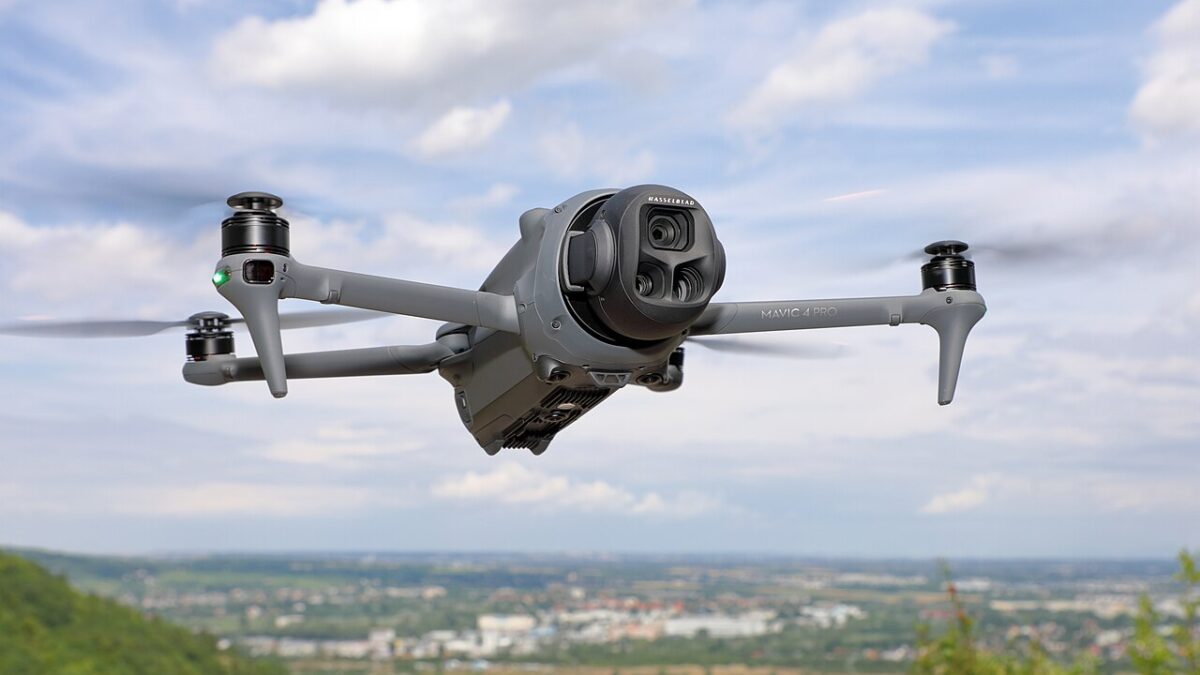
Featured image: DJI Mavic 4 Pro by C.Stadler/Bwag, Wikimedia Commons (CC BY-SA 4.0)
Deixe um comentário