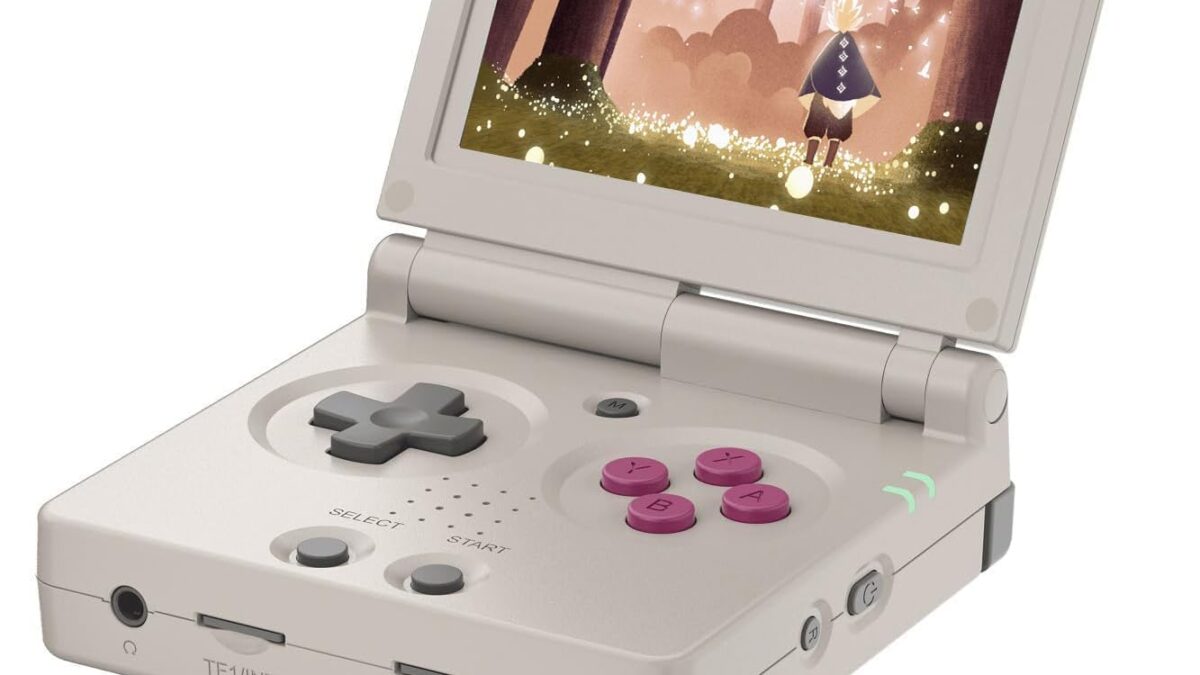
The Game Boy Advance SP defined a shape: a screen that folds shut, a hinge that survives a backpack, a form factor you don’t think twice about pocketing. Twenty-two years later, that shape is back — not from Nintendo, but from a Shenzhen hardware maker most casual buyers have never heard of. The Anbernic RG35XXSP ($74.98) is the clearest expression yet of the retro-handheld boom’s current obsession: clamshell nostalgia over raw horsepower.
This review works from the live Amazon.com listing — specs, price, and the 3.9-star aggregate rating as of publication — rather than a hands-on unit. Where a claim needs a real-world benchmark (frame-rate ceilings, exact battery runtime under load), that gap is flagged explicitly rather than papered over.
Disclosure: DecodeGear may earn a commission from qualifying purchases made through the Amazon links in this article, at no extra cost to you.
Quick Verdict: Anbernic RG35XXSP
A $75 flip-screen retro handheld built around a quad-core H700 chip, a 3.5″ 640×480 IPS panel behind tempered glass, and 64GB of preloaded emulation content. It’s a budget emulation console wearing a GBA SP costume — buy it for the form factor and the price, not for cutting-edge performance.
Score: 7.6/10 | Price: $74.98
Design and Build: The Hinge Is the Whole Pitch
Anbernic’s product line makes this comparison unavoidable: the standard RG35XX (no “SP” suffix, roughly $55–65) is a flat brick with a d-pad and buttons — functionally similar internals, no clamshell. The RG35XXSP adds a hinge, a screen that folds face-in, and the resulting pocketability, for a roughly $10–15 premium over the flat model. That’s the entire value proposition in one sentence, and it’s worth being honest about it up front rather than dressing it up as more than it is.
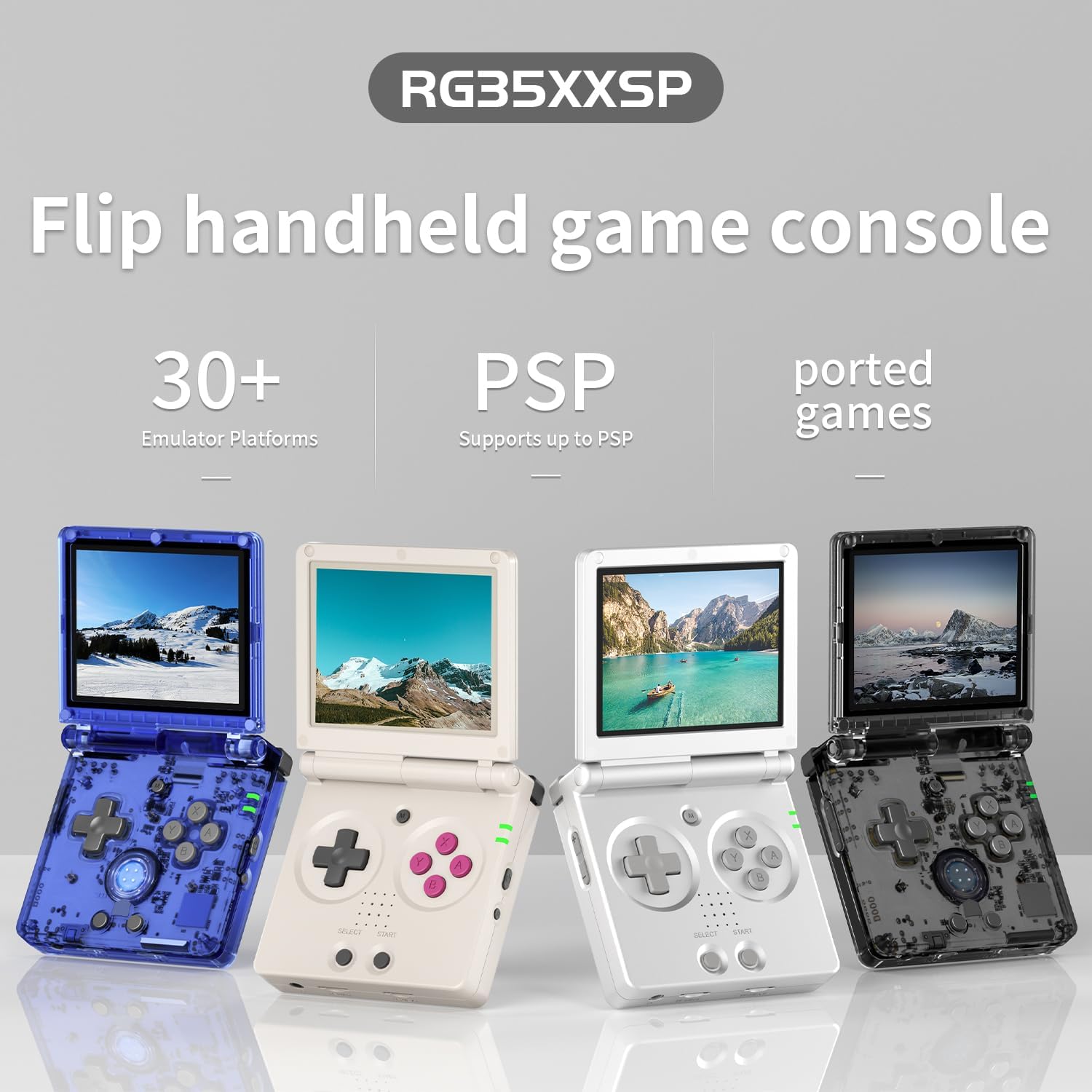
Per the manufacturer listing, the shell uses a tempered-glass screen cover rated for scratch and drop resistance — a detail that matters more here than on most handhelds, since a clamshell hinge is a second failure point flat consoles don’t have. Anbernic has iterated on this hinge across several generations (RG35XX, RG34XX, now the SP variants), which at minimum suggests the mechanism isn’t a first attempt.
Screen: Good Enough for the Games It’s Built to Run
The 3.5-inch IPS panel runs at 640×480 — a resolution chosen for one reason: it maps cleanly onto the low native resolutions of PS1, GBA, and 16-bit console emulation without the scaling artifacts you’d get pushing those sources to a 1080p panel. Anbernic advertises “full viewing angle” IPS with OCA full lamination, which in practice means less of the air-gap glare you’d see on a cheaper panel stack. For the systems this device targets, 640×480 is not a limitation — it’s arguably the correct spec, not a corner cut.
Chip and Emulation Range: Where the Ceiling Actually Sits
The H700 is a quad-core ARM Cortex-A53 clocked at 1.5GHz, paired with a dual-core Mali-G31 MP2 GPU. In plain terms: this is entry-level smartphone-class silicon from several years ago, repurposed for a dedicated gaming device. That’s not a knock — it’s the same tier of chip most sub-$100 retro handhelds use, and it’s more than sufficient for the systems the RG35XXSP is actually built around: NES, SNES, Game Boy/Color/Advance, Genesis, and PlayStation 1.
Where the ceiling shows up is anything demanding more: N64 and Dreamcast emulation on H700-class chips is historically inconsistent — playable on lighter titles, choppy on 3D-heavy ones — and PSP is largely out of reach. If your interest is strictly 8-bit and 16-bit era gaming plus PS1, the chip is not the bottleneck. If you’re hoping for a pocketable N64 machine, look at Anbernic’s higher-tier RG406V or RG556 instead — different chip class, different price bracket.
Battery: Reasonable Numbers for the Category
The listing specifies a 3,300mAh battery rated for up to 8 hours of play, charged via USB-C at 5V/1.5A. That capacity-to-runtime ratio is in line with what similarly sized Anbernic devices report — not class-leading, but not a compromise either. Real-world runtime on any handheld varies with screen brightness and emulated system (PS1 draws meaningfully more power than a Game Boy core), so treat “8 hours” as a ceiling figure reached only at lower brightness on lighter emulation loads, not a floor.
Software and the 64GB Card: The Part Buyers Should Read Carefully
The unit ships with a 64GB card preloaded with 5,532 games, running a Linux-based OS that supports adding emulators and ROMs. Two things to flag here rather than gloss over: first, “5,532 games” is a raw file count, not 5,532 distinct, playable-out-of-the-box titles — preloaded ROM sets on budget handhelds routinely include duplicates, regional variants, and homebrew filler alongside the real library. Second, and more important: the legality of preloaded ROM content depends on your jurisdiction and what you already own. This review evaluates the hardware Anbernic sells and describes what the manufacturer states ships on the card — it is not a legal endorsement of ROM distribution, and buyers uncomfortable with that gray area can wipe the card and load only content they’ve legally dumped themselves.
On the connectivity side, the RG35XXSP supports TV output, 2.4GHz wireless controller pairing, and wired controller input — useful if you want to dock it to a television for couch play, which is a genuinely differentiating feature at this price point.
How We Compared These Picks
DecodeGear doesn’t physically test every unit it covers — this review is built from the live product listing (specs, pricing, 3.9-star rating as of publication) and Anbernic’s own published spec sheet, cross-referenced against the rest of the company’s current lineup for context. Where a claim is manufacturer-stated rather than independently measured — the 8-hour battery figure, the “5,532 games” count — that distinction is called out explicitly above rather than repeated as fact. If you want frame-rate-level emulation benchmarks for the H700 chip, retro-handheld enthusiast communities (RetroHandhelds subreddit, dedicated YouTube teardown channels) publish per-core, per-system testing that goes deeper than a specs-based review can.
Who Should Buy the RG35XXSP (and Who Shouldn’t)
Buy it if: you want a pocketable, flip-screen device dedicated to 8-bit/16-bit and PS1-era emulation, you like the GBA SP form factor specifically, and $75 is your ceiling. If you’re already invested in the retro-handheld space — check out our deep dive on why tiny retro handhelds are suddenly everywhere for the broader trend this device rides.
Skip it if: you want N64/PSP-level emulation headroom (spend more, further up Anbernic’s lineup), or you’d rather have a general-purpose small-form-factor gaming device — our best mini PCs under $300 roundup covers that adjacent category.
Frequently Asked Questions
Is the Anbernic RG35XXSP better than the standard RG35XX?
Not in raw performance — both use comparable internals. The SP variant’s entire upgrade is the flip/clamshell design and the tempered-glass screen protection it enables, for roughly $10–15 more.
Can the RG35XXSP play N64 games well?
Inconsistently at best. The H700 chip handles 8-bit/16-bit systems and PS1 comfortably but is undersized for N64’s 3D workload — expect frame drops on demanding titles.
Do I need to add my own games?
No — it ships with a 64GB card preloaded with content, though buyers should verify the legality of preloaded ROMs in their own jurisdiction and can replace the card’s contents with their own legally-dumped files if preferred.
Does it work with a TV?
Yes — TV output is supported, along with 2.4GHz wireless and wired controller pairing for couch-style play.
Leave a Reply