How a $50 Keyboard Beat the $200 Ones — And Changed Gaming Forever
It was 2017, and a small Hong Kong startup called Keychron was about to do something the keyboard industry had quietly agreed was impossible: sell a mechanical keyboard with hot-swappable switches, solid aluminum weight, and Cherry-compatible layout for under $80. The big brands had a meeting about this, probably. The meeting probably went poorly.
The budget mechanical keyboards revolution didn’t happen with a press release. It happened product by product, subreddit post by subreddit post, unboxing video by unboxing video — until one day you looked up and the $200 gaming keyboards were losing to $50 boards in every blind switch test, every build quality comparison, every “which should I buy?” thread. This is that story.
The Era When Keyboards Were Boring
Go back to the late 1990s and early 2000s. The keyboard market had made a decision: rubber domes were good enough. Membrane keyboards — where a rubber dome beneath each key creates the actuation — became the default for virtually every office, home computer, and gaming setup on the planet. They were quiet, cheap to manufacture, and totally, completely soul-destroying to type on.
Mechanical switches did exist. The IBM Model M from 1984, with its buckling-spring mechanism, remains one of the most tactile keyboards ever made. Cherry MX switches, developed in Germany, powered a handful of professional and enthusiast boards through the ’80s and ’90s. But these were expensive, loud, and largely invisible to mainstream consumers. A mechanical keyboard in 2005 cost $150 or more — and that was before the enthusiast premium. For most people, the beige rubber-dome board that came in the box with their PC was all they’d ever know.
Gaming brands noticed mechanical switches in the late 2000s. Razer launched the BlackWidow in 2010. SteelSeries, Corsair, and Logitech followed. They marketed the clicky feedback as a competitive advantage — faster actuation, more reliable keystrokes, the pro gamer edge. The price tags reflected the positioning: $150 to $250 was standard. Mechanical keyboards were officially a premium product, and the industry intended to keep them that way.
The Enthusiast Underground
Here’s the thing nobody expected: while the gaming brands were busy charging $200 for switches wrapped in RGB plastic, an entirely separate community was building something different.
Reddit’s r/MechanicalKeyboards subreddit launched in 2010. It grew slowly at first — a few thousand hobbyists sharing their custom builds, discussing switch weights and actuation curves, debating whether PBT keycaps were worth the premium. By 2014 the community had around 10,000 members. By 2020 it was over 400,000. Today it sits above 800,000. That’s not a niche — that’s a market.
The enthusiast community was doing something the gaming brands were not: they were actually obsessing over quality. Group buys for custom keyboards with gasket-mounted PCBs and thick brass plates. Lubricating their own switches with krytox grease. Designing custom keycap sets with a devotion that would embarrass most industrial designers. The language these communities developed — “thock,” “clack,” “linear vs. tactile vs. clicky,” “north-facing vs. south-facing PCB” — became the vocabulary of a new kind of keyboard literacy.
And crucially, this community was sharing everything. Which switches were worth it. Which stabilizers needed lubricating. Which cheap boards punched above their weight. The information was free, the reviews were honest, and the brands couldn’t control the narrative. That was about to matter enormously.
The Turning Point Nobody Saw Coming
The democratization of quality came from an unexpected direction: Chinese manufacturing that stopped cutting corners.
Brands like Akko, Epomaker, and NuPhy emerged from the same manufacturing ecosystem that had always existed — but they came with a different philosophy. Instead of licensing Cherry MX switches and marking them up, they developed their own switches with comparable (sometimes superior) specifications. Instead of cheap ABS plastic that shines after three weeks of use, they shipped PBT keycaps as standard. Instead of soldered PCBs that made switch replacement a soldering job, they offered hot-swap sockets.
Keychron was the catalyst. Their C1 and K-series boards hit the market at $40–$70 and earned genuinely good reviews from enthusiasts who expected to find compromises and kept not finding them. The hot-swap feature — previously associated with custom builds costing $300+ — made it into a mainstream product. Suddenly, a beginner could buy a $60 board and swap to their preferred switches without a soldering iron. That changed everything about the barrier to entry.
The numbers tell the story. In 2015, a “good” mechanical keyboard cost $150 or more. By 2020, credible options existed at $80–$100. By 2024, a genuinely excellent daily driver — solid build, PBT keycaps, hot-swap, good stabilizers — was available for $40 to $60. The price of quality had collapsed by roughly 75% in under a decade.
Why the $200 Brands Panicked
Corsair, Razer, and Logitech had built their keyboard businesses on a simple premise: mechanical switches were the premium feature, and they controlled access to the premium tier. When Chinese manufacturers commoditized the switches and the build quality simultaneously, those brands were left with a marketing story but not a product story.
Their response, with very few exceptions, was not to improve the keyboards. It was RGB lighting. More RGB. Per-key RGB, underglow RGB, software-controlled RGB with 16.8 million colors. Keyboards that could sync with your GPU lighting and your mouse lighting and your case fans. Marketing language pivoted hard toward “gaming ecosystem” and away from any specific claim about typing feel or switch quality.
This was a tell. When a brand stops talking about its product’s core function and pivots to spectacle, it’s usually because the core function no longer justifies the price. The $200 Corsair K100 and the $250 Razer BlackWidow V4 Pro are impressive hardware in certain respects — but in a blind typing test against a $90 Keychron V1 Max, most users couldn’t identify which was which. Several couldn’t tell which felt better. That’s a problem if you’re charging 2–3x the price.
The gaming keyboard segment responded more slowly than it should have. Some brands eventually introduced their own hot-swap boards and improved stabilizer configurations. Logitech’s GX switches are genuinely competitive. But the price premium remained — and the enthusiast community, now 800,000 strong and growing, was increasingly vocal about whether it was justified.
What Budget Mechanical Keyboards Mean If You’re Buying Today
The keyboard market in 2026 is the most buyer-friendly it has ever been. Budget mechanical keyboards are no longer a compromise — they are the baseline. A first-time buyer today has access to hardware that would have been considered enthusiast-grade five years ago, at a fraction of the price.
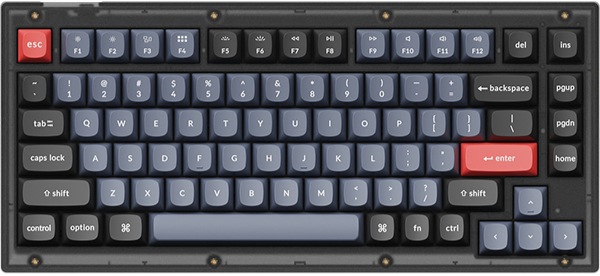
The Keychron V1 Max sits around $90 and delivers a wireless, hot-swap, gasket-mounted keyboard with excellent stock switches and PBT keycaps. The Akko 5075B comes in around $70 with a comparable feature set. Both genuinely outperform $150–$200 gaming keyboards from major brands in switch feel, build resonance, and keycap quality. Not because the budget boards are exceptional — though they are good — but because the gaming brands stopped investing in those dimensions of quality.
The question to ask is not “how much should I spend?” It’s “what do I actually need?” For most people — gaming, work, or both — the $50–$90 tier now covers every functional requirement. Hot-swap means you can change switches if your preferences evolve. PBT keycaps mean the legends won’t fade. Gasket mounting means a quieter, more cushioned typing experience. These are not premium-tier features anymore. They’re standard.
If you’re trying to find the right starting point in this market, our guide to the best budget mechanical keyboards under $75 covers the current field in detail — which boards survive daily use, which switches are worth starting with, and where the remaining trade-offs actually live.
The revolution happened quietly, one unboxing video and one subreddit post at a time. The $200 keyboard isn’t dead — but it needs to earn its price now. And for the first time in decades, the $50 board is making that very difficult. If you want to experience where this story has landed — the board that arguably started it all and still represents the best value in the category — the Keychron V1 Max is worth every dollar of its very reasonable ask.
Deixe um comentário