Most humidifier shopping goes wrong at the spec sheet. Buyers compare “coverage area” numbers on the box, pick whichever one covers the biggest room on paper, and end up with either a unit that can’t keep up with a real bedroom or one that overshoots and fogs up the windows. Knowing how to choose a humidifier really comes down to three variables — type, size, and maintenance — and the marketing copy rarely leads with any of them.
This post contains affiliate links. If you buy through one, we may earn a commission at no extra cost to you.
Get the type, the size, and the maintenance routine right, and a humidifier is a $60-$100 appliance that quietly fixes dry winter air, static shocks, and cracked skin. Get any one of those three wrong, and it’s either useless or — worse — a source of mold and bacteria you’re actively misting into the room.
How to choose a humidifier type: evaporative vs ultrasonic vs steam
There are three mechanisms on the market, and the difference isn’t cosmetic — it changes how the unit fails when you skip maintenance.
Ultrasonic units vibrate water at high frequency to create a fine, cool mist. They’re quiet — often under 30dB — and compact, which is why they dominate the “best for bedrooms” category. The tradeoff: they aerosolize whatever’s dissolved in your water, including minerals. Use tap water and you’ll eventually see a fine white dust settle on nearby furniture. The EPA’s own guidance is blunt about this — use distilled or demineralized water in ultrasonic units if you want to avoid it.
Evaporative units pull water through a wicking filter while a fan blows air across it. They self-regulate somewhat — as the air gets more humid, evaporation naturally slows — which makes them harder to over-humidify by accident. No mineral dust, since minerals stay in the filter instead of the air. The cost is more noise (there’s a fan) and a recurring filter-replacement expense.
Steam (warm mist) units boil water before releasing it, which kills most bacteria in the tank by default — a real hygiene advantage — but they draw more power, get hot to the touch, and are a genuine burn risk if you have small kids or pets that might knock one over. Most buyers outside households with that specific risk profile are better served by evaporative or ultrasonic.
Sizing it to your room (the number that actually matters)
Ignore the “covers up to 500 sq ft” language on the box for a second. The figure that predicts real-world performance is gallons per day (GPD) of output relative to your room’s air volume, not just its floor area — a room with 10-foot ceilings needs meaningfully more output than the same footprint with 8-foot ceilings.
As a rough baseline: a small bedroom (under 300 sq ft) is well served by a compact unit outputting 1-2 gallons per day. A larger bedroom or open living space (300-500 sq ft) typically needs 2-4 GPD to keep pace, especially in dry winter climates. Whole-floor coverage generally means either a large-tank console unit or accepting that you’ll be refilling a smaller one more than once a day.
Noise level — why this matters more than most buyers realize
A humidifier that runs 8+ hours overnight in a bedroom needs to be genuinely quiet, not just “quiet for a humidifier.” Ultrasonic units typically run 25-35dB — comparable to a whisper. Evaporative units with a fan usually land in the 35-45dB range, closer to a quiet conversation, though higher-end models with better fan design close that gap.
If the unit is going in a nursery or a light sleeper’s bedroom, prioritize a published dB rating over a coverage number. A humidifier you turn off at 2am because it’s too loud is a humidifier that isn’t doing its job for the other six hours.
Pro tip: what most people get wrong about maintenance and mold risk
Here’s the insight that doesn’t make it onto most buying guides: the technology you pick matters less than how consistently you clean it. Both the EPA and Mayo Clinic have documented that humidifiers of any type — left with standing water for days — become a breeding ground for bacteria and mold, which the unit then actively disperses into the air you’re breathing. That’s not a hypothetical; it’s been linked to flu-like symptoms in otherwise healthy people, and it’s a real aggravator for anyone with asthma or allergies.
The fix is boring but effective: empty and dry the tank between fills rather than topping it off, and do a full vinegar-and-water deep clean weekly. If a specific model makes that process genuinely easy — dishwasher-safe parts, wide-mouth tank openings — that’s worth more than an extra 0.5 gallons of tank capacity.
Smart/app-connected humidifiers — worth the premium?
App control adds real value in one specific way: it lets you set a target humidity percentage rather than a vague “low/medium/high” dial, and the unit stops misting once it hits that target instead of running unsupervised at max output. For anyone who’s dealt with condensation on windows from an over-humidified room, that auto-shutoff is the actual selling point — not the novelty of controlling it from your phone.
Where it doesn’t pay off: if you’re the type who sets a humidifier once at the start of winter and doesn’t touch it again, you’re paying for scheduling and voice-assistant integration you’ll never use. A simple model with a built-in hygrostat gets you 90% of the practical benefit for less money.
Our pick: which humidifier to choose for most homes
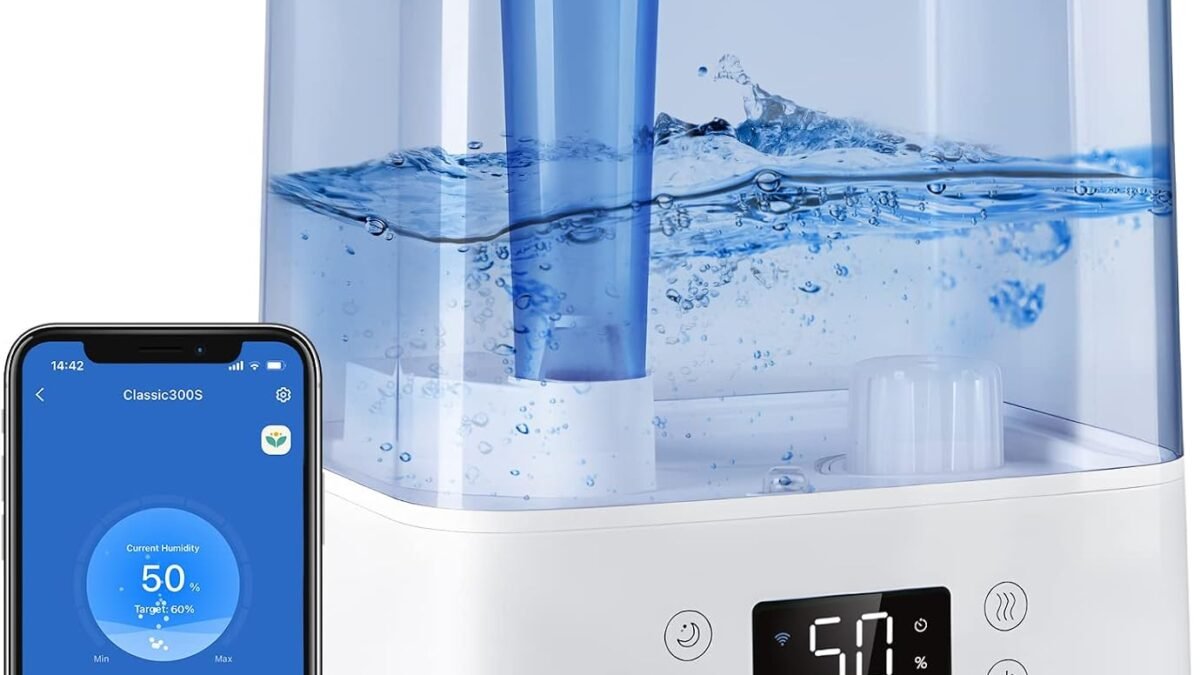
For a bedroom or nursery where quiet, precise humidity control matters most, the Levoit Classic 300S is the ultrasonic pick worth the money. It’s rated under 30dB, holds 6 liters (up to 60 hours of runtime before a refill), and its free app lets you set an exact humidity target with Alexa/Google integration — which, per the section above, is the smart-home feature that’s actually worth having here. Just plan to run it on distilled water to sidestep the ultrasonic mineral-dust issue.
Best for bedrooms: Levoit Classic 300S
6L tank, under-30dB ultrasonic mist, app-controlled humidity targeting.
Price: ~$94
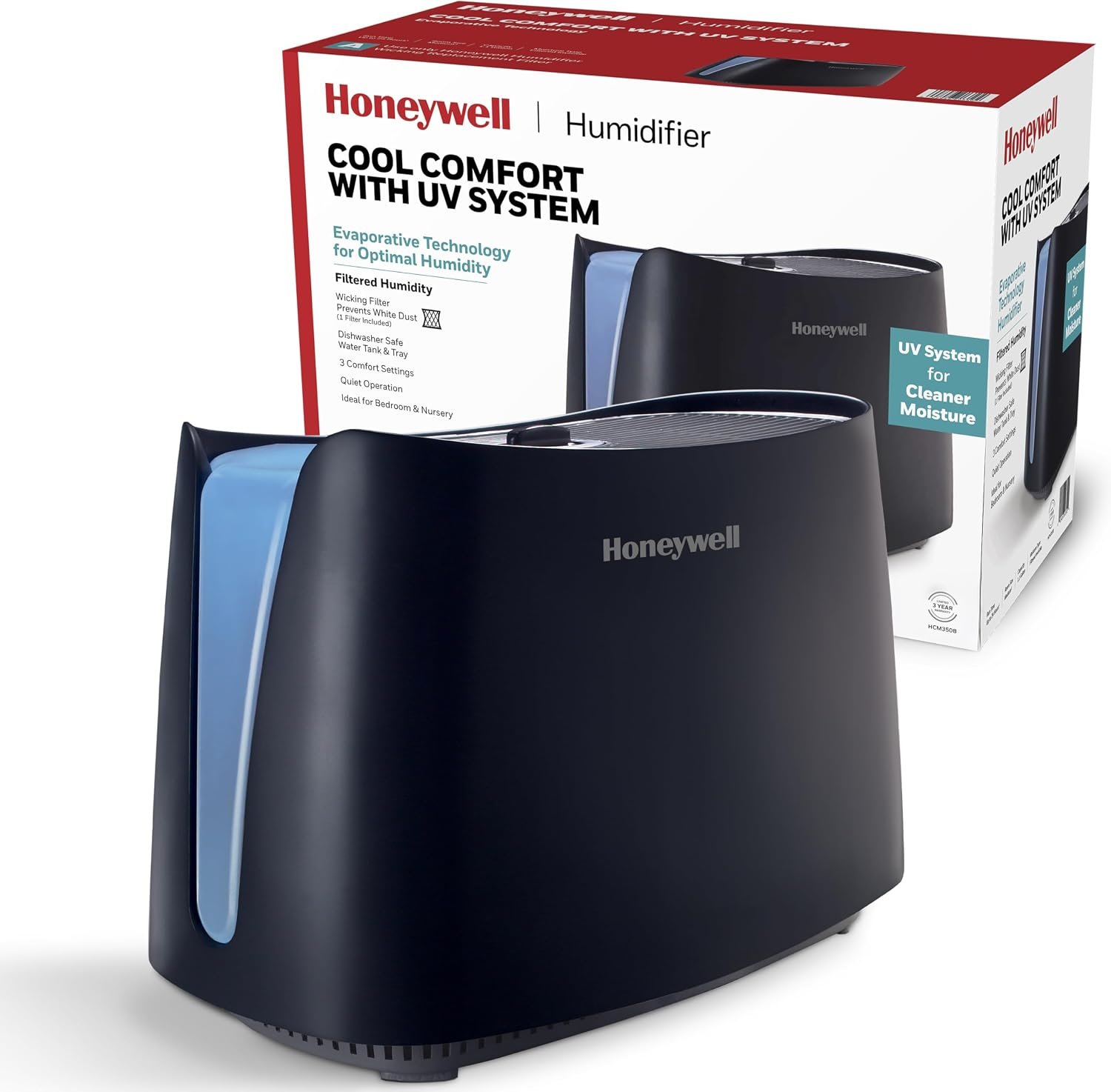
If mineral dust or over-humidification worries you more than noise — say, you’ve got allergy sufferers in the house or hard tap water — the Honeywell HCM350 is the better fit. Its evaporative wick-and-UV design self-limits output and produces essentially no white dust, at the cost of some fan noise and a recurring filter cost.
Best for allergy-sensitive homes: Honeywell HCM350
1.1-gallon tank, evaporative + UV, self-regulating, dishwasher-safe parts.
Price: ~$76
If you’re setting this up as part of a broader smart home rather than a standalone gadget, it’s worth getting the fundamentals right first — our guide to setting up a mesh Wi-Fi system covers the connectivity a smart humidifier depends on, and if you’re at all worried about who else might have access to app-connected devices in your home, our piece on securing your smart home devices is worth reading first. And if dry air is only half your indoor air problem, our roundup of the best air purifiers for large rooms covers the other half.
Frequently Asked Questions
What humidity level should I actually target?
The EPA recommends keeping indoor relative humidity between 30% and 50%. Above that range promotes mold and dust mites; below it dries out skin, airways, and wood furniture. A cheap digital hygrometer (often bundled with smart humidifiers) is the only reliable way to know your actual number — guessing by feel is not accurate.
How often do I actually need to clean a humidifier?
Empty and dry the tank daily rather than topping it off, and do a full vinegar-based deep clean once a week during heavy use. Skipping this is the single biggest cause of both bad odors and the bacteria/mold dispersal issue covered above.
Is distilled water really necessary?
Only for ultrasonic units. Evaporative and steam humidifiers handle tap water fine since minerals stay behind in the filter or the boiling chamber. For ultrasonic models, distilled or demineralized water is the difference between clean mist and a fine white dust on your furniture.
Can a humidifier make allergies worse instead of better?
Yes, if it’s not cleaned regularly or if it pushes humidity above 50%, both of which encourage mold and dust mite growth — the exact allergens a humidifier is supposed to help with. Choose an evaporative or steam model and stick to the cleaning cadence above if allergies are a primary concern.
Leave a Reply