Sony’s RX10 V Superzoom Is Official — Price, Specs, and Everything to Know Before It Ships in August
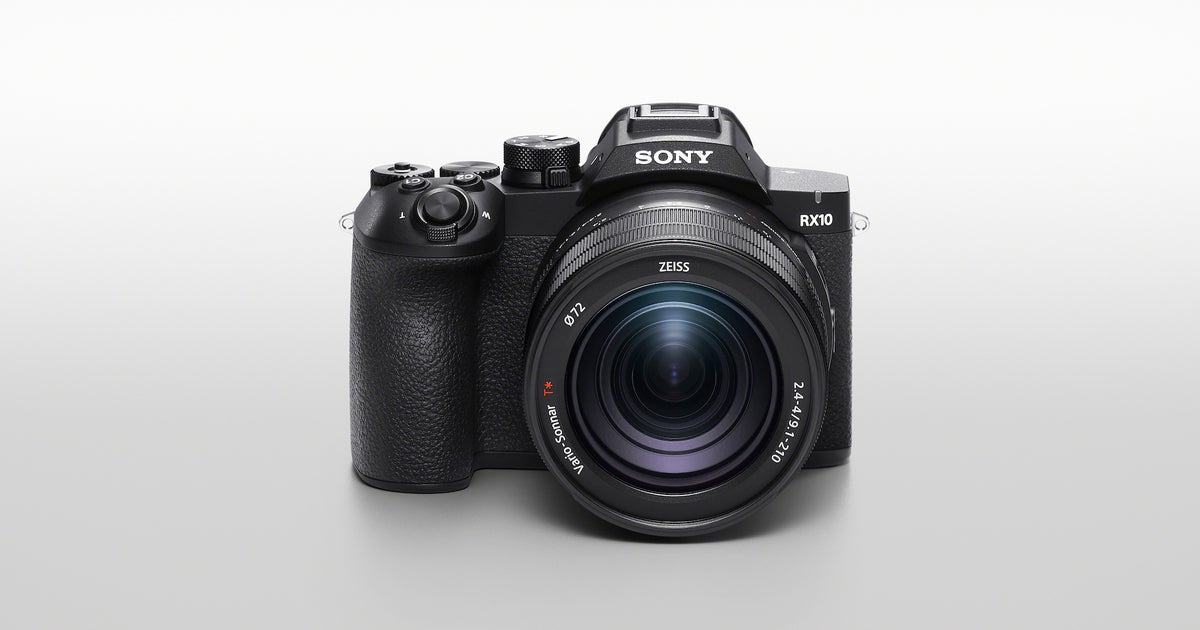
Sony has revived its RX10 bridge-camera line for the first time in nearly a decade. The RX10 V, announced July 9, keeps the same 24-600mm-equivalent ZEISS lens and 20.1MP 1-inch stacked sensor as its 2017 predecessor, but drops in a new processor, a dedicated AI chip, and a significant video upgrade. It ships in early August at $2,299.99, with preorders open now.
What’s actually new
The headline spec — that 25x zoom range covering 24-600mm in a single fixed lens — is unchanged from the RX10 IV, and so is the sensor. What Sony rebuilt is everything around them. A BIONZ XR processor and a dedicated AI processing unit now handle Real-time Recognition autofocus borrowed from Sony’s Alpha mirrorless line, letting the camera identify and track people, animals, birds, insects, cars, trains, and aircraft — not just faces and eyes, which is roughly what the RX10 IV topped out at.
Burst shooting jumps to 30fps blackout-free, with continuous AF/AE tracking holding through the full sequence. Video gets the bigger leap: 4K 60p in 10-bit All-Intra, 4K 120p slow motion, and S-Log3 for color grading — none of which existed on the 2017 model, which was capped at 4K 30p.
Why Sony waited nine years to update this
The RX10 line sits in an awkward spot that’s only gotten more awkward since 2017: a fixed-lens bridge camera competing against mirrorless bodies that have gotten smaller, cheaper, and paired with increasingly capable superzoom lenses of their own. For years, that made the RX10 IV feel like a camera Sony had simply stopped investing in — still sold, rarely updated, quietly aging against smartphone computational zoom on one end and compact mirrorless kits on the other.
The RX10 V’s answer isn’t a redesign — it’s proof the fixed 24-600mm bridge format still has a job that neither smartphones nor interchangeable-lens kits do well: one lens, one body, zero lens changes, covering everything from a wide group shot to a bird 500 feet away, without the weight or cost of a mirrorless body plus an equivalent zoom lens (which alone would run well past $2,000 before you add a camera).

Who this is actually for
At $2,299.99, the RX10 V isn’t competing with point-and-shoots — it’s positioned against travel and wildlife shooters who’d otherwise be carrying a mirrorless body and a 100-400mm or 200-600mm lens combo costing considerably more and weighing considerably more. Early hands-on coverage from outlets who attended the announcement frames it squarely as a travel, wildlife, and sports camera: one bag, one lens, ready for whatever shows up in frame.
The trade-off hasn’t changed since 2017: a 1-inch sensor can’t match the low-light performance or background separation of a full-frame or APS-C body. If you mostly shoot indoors or in dim venues, this was never the camera for you, and it still isn’t. If your photography happens outdoors and the subject keeps moving — wildlife, kids’ sports, travel where changing lenses mid-hike isn’t realistic — the RX10 V’s pitch is that it’s the last camera you’ll need to pack.
What’s next
Preorders are open now through Sony’s own store and major retailers, with shipping confirmed for “early August 2026.” Sony hasn’t announced a firm street date beyond that window. Given the RX10 IV stayed in Sony’s lineup for nine full years after its release, buyers picking up the V now are likely looking at a camera that’ll still be current well into the next decade — for better or worse, depending on how you feel about paying $2,300 for a sensor design that’s already eight years old.
That price also puts it in direct conversation with Sony’s own Alpha 6700 or a6700-class body paired with a superzoom lens, which can undercut the RX10 V on sensor size (APS-C vs. 1-inch) while landing in a similar total price once you factor in a comparable lens. Sony’s bet is that most buyers don’t want to make that lens decision at all — the RX10 V’s whole pitch is removing that step entirely, at the cost of some low-light and background-blur performance a bigger sensor would deliver.
If you’re deciding between a superzoom bridge camera and going the mirrorless-plus-lens route instead, our action camera comparison guide covers the tradeoffs for the more compact end of that spectrum, and our guide to choosing a camera for streaming and video is worth a look if 4K 120p slow-motion is what actually caught your attention here.
Sources: Sony / PR Newswire, PhotoWorkout, CineD
Deixe um comentário