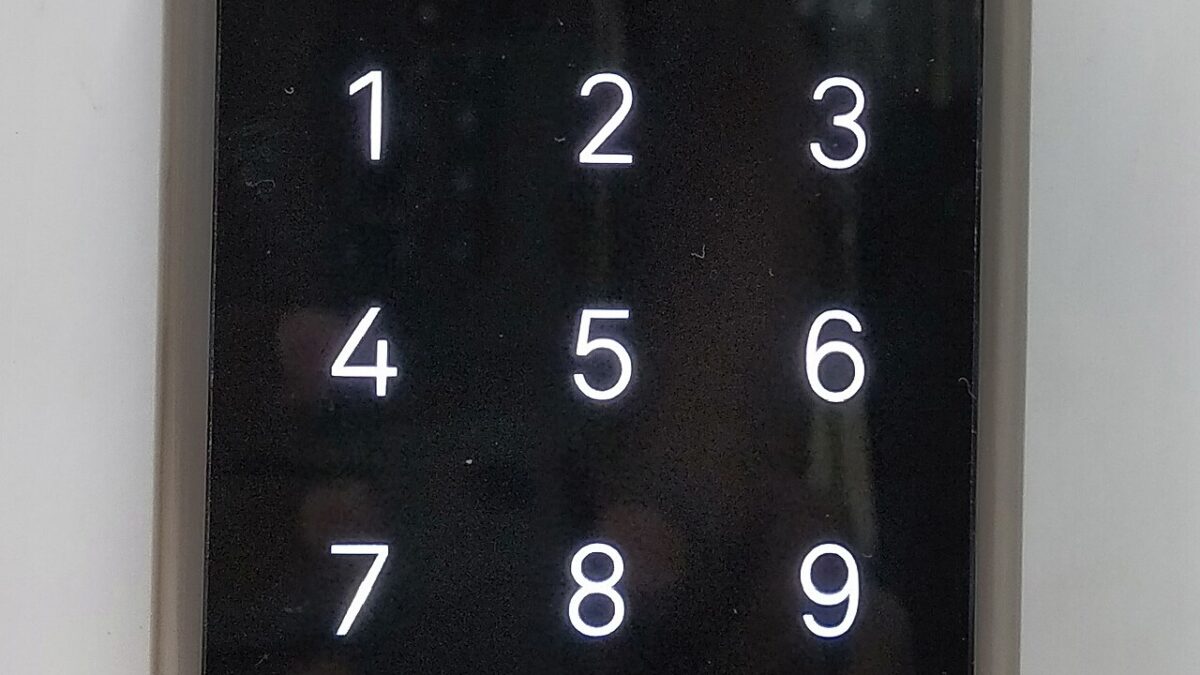
Battery-Free Smart Locks Are Here — How AuraCharge Works and Whether It’s Worth Buying in 2026
It’s 11 p.m., you’re standing on your own porch, and the keypad on your smart lock is blinking red. The battery died sometime between your last grocery run and now, and you have no physical key because you haven’t needed one in two years. This is the single biggest complaint about smart locks, and in 2026 a small cluster of manufacturers is finally trying to kill it for good with a battery-free smart lock — a deadbolt that draws continuous power out of thin air instead of four AA batteries.
The most talked-about version of this idea is Lockin’s V7 Max, which uses a system called AuraCharge: a wireless infrared module mounted on the interior side of the door that beams power to the lock, all day, with nothing to plug in and nothing to swap out. This guide explains exactly how that works, how it’s different from the “long battery life” claims every other lock makes, and whether it’s worth buying instead of a normal smart lock in 2026.
How Traditional Smart Locks Work — and Why the Battery Always Dies at the Worst Time
Every keypad or app-controlled deadbolt on the market today, from a $60 budget lock to a $300 Schlage, runs on the same basic principle: a small electric motor throws the bolt, and that motor is powered by a battery pack, usually four AA cells sealed behind the interior faceplate. The electronics that handle the keypad, Bluetooth, Wi-Fi, or Z-Wave radio also draw from that same pack, continuously, even when nobody is touching the lock.
That’s why battery life is so inconsistent. Most locks are rated for six months to a year under normal use, but models with built-in Wi-Fi — which must stay awake to talk to your router — often burn through batteries in three to six months, per testing round-ups from BUTTERFLYMX and SmartLockMFG. Cold weather makes it worse, since alkaline batteries lose capacity as temperatures drop. A misaligned door adds more drain still, because the motor has to fight the frame on every throw.
Most locks do send a low-battery push notification weeks ahead. That’s little comfort when notifications get ignored, phones die, or the person who gets the alert isn’t the one standing at the door when the battery finally quits — locked out at night, mid-delivery, or with guests waiting in the driveway.
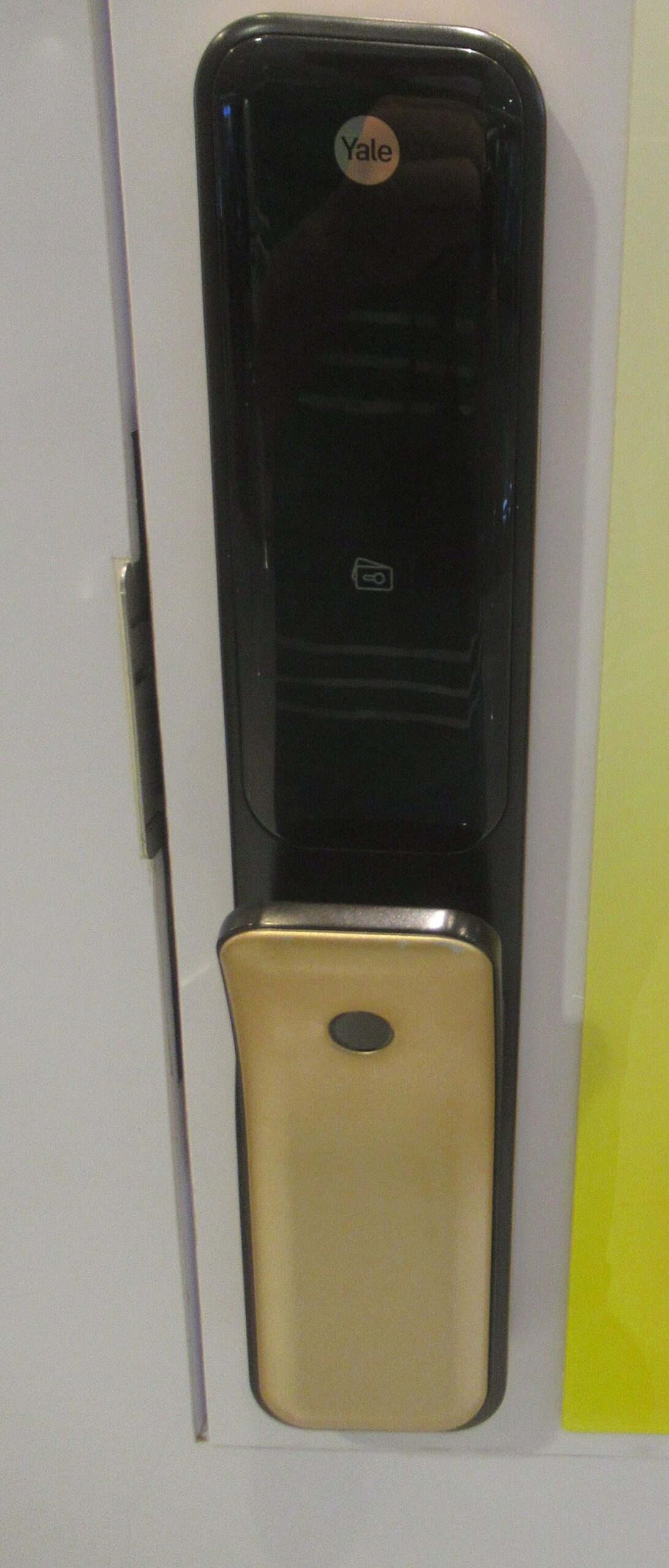
What Is AuraCharge? Inside the First Battery-Free Smart Lock
AuraCharge is Lockin’s implementation of a wireless optical power technology originally developed by Wi-Charge, a company that has also partnered with Schlage to retrofit its Encode locks with the same idea. Instead of storing energy in a battery, the lock receives it live, continuously, from a small transmitter mounted somewhere on the interior wall or hallway.
The mechanism, in plain terms: the transmitter emits an invisible, eye-safe infrared beam — Class 1, the same safety category as a TV remote — toward a receptor built into the inside panel of the lock. That receptor converts the beam into electricity in real time, the way a solar panel converts sunlight, except it works at night and indoors. Wi-Charge’s own documentation puts the effective range at roughly one to ten meters, within an 80-degree cone, so the transmitter and lock need a clear line of sight — not a wall or closed door between them.
If the beam gets blocked — someone walks through it, furniture moves, the transmitter loses power — the V7 Max doesn’t just die. Early reporting from T3 and Robb Sutton found it carries an internal backup battery good for roughly a week on its own: not “no battery ever,” but “a battery that almost never does the work.” Preorders opened in January 2026 with shipping targeted for March, and independent pricing trackers put it at roughly $1,000–$1,300 — four to five times a standard Schlage or Yale, reflecting a flagship feature set: triple biometric unlock (finger-vein, palm-vein, 3D facial) plus a built-in video doorbell.
Beyond Lockin: Matter, Fail-Safes, and Where the Rest of the Market Stands
It’s worth being precise about what’s actually new versus well-marketed. Matter — the smart-home standard backed by Amazon, Google, Apple, and Samsung, which we break down in full in our guide to what Matter actually is — solves a different problem entirely: it lets a lock from one brand talk to a hub from another without separate apps. Kwikset’s Halo Touch and Halo Select, Schlage’s Encode Plus, and several Ultraloq models are all Matter-certified in 2026 — but Matter says nothing about how a lock is powered. Every one of them still ships with a standard AA battery pack. Matter fixes ecosystem lock-in; it does not touch the battery problem.
The fail-safe conversation is separate again. Reputable smart locks, battery-free or not, are built so that a total power loss doesn’t strand you: most include a physical key override, a 9-volt backup terminal you can touch to the outside of the lock to jump-start it, or, in AuraCharge’s case, that internal reserve battery. If you’re shopping and a lock doesn’t clearly document one of these fail-safes, that’s a bigger red flag than its battery rating.
If you’re ready to shop for something that doesn’t require rethinking your entryway wiring, our best smart locks roundup breaks down the top picks for every budget, including several Matter-ready options that balance battery life against price. And if a smart lock is just one piece of a bigger project, our guide to building a smart home on a budget covers how to sequence purchases so you’re not buying gear that fights itself.
Is a Battery-Free Smart Lock Worth Buying in 2026?
Our take: worth it for a specific buyer, not for most people
If you’ve replaced smart lock batteries more than once a year, live somewhere cold, or run a rental property where a dead battery means an angry guest, AuraCharge solves a real, recurring cost. For everyone else, a well-reviewed Matter lock with a 9-volt backup terminal solves 90% of the same anxiety for a quarter of the price.
Pro tip: what most buyers miss about “battery-free”
The detail that gets lost in the headlines is installation. A snap-over lock like an August or SwitchBot mounts on top of your existing deadbolt in about ten minutes. The V7 Max replaces the entire locking mechanism and typically needs a mortise cutout — professional installation is strongly recommended, and that’s before you’ve found a spot for the transmitter that isn’t an eyesore. Budget for an installer’s time, not just the sticker price.
It’s also worth noting what AuraCharge doesn’t include: as of this guide, the V7 Max supports Matter but has no native Apple Home Key, which is a real gap if your household is deep in the Apple ecosystem and wants tap-to-unlock with an iPhone or Apple Watch.
FAQ
Does a battery-free smart lock still have a battery at all?
Yes, effectively. The V7 Max’s AuraCharge includes a small backup battery, good for about a week, that kicks in only if the power beam is interrupted. “Battery-free” describes normal operation, not the total absence of a cell inside the lock.
Do I need a clear line of sight for the transmitter to work?
Yes. Wi-Charge-based systems need an unobstructed path between the transmitter and the lock’s receptor, typically within an 80-degree cone and a range of one to ten meters. A closed door or furniture in the wrong spot can block the beam.
Is Matter the same thing as battery-free?
No. Matter lets locks work across Alexa, Google Home, and Apple Home without separate apps — it has nothing to do with power. Matter-certified locks like the Kwikset Halo Select and Schlage Encode Plus still use standard AA batteries.
How much more expensive is a battery-free smart lock than a normal one?
Significantly. Early pricing for the Lockin V7 Max sits around $1,000–$1,300, versus $150–$330 for well-regarded Matter-certified locks. You’re paying for the charging tech plus a flagship feature set — biometrics, cameras, AI — not the battery-free mechanism alone.
Battery-free charging is genuinely clever engineering, not a gimmick — Wi-Charge’s optical power tech is already shipping on Schlage hardware too, so the idea has legs beyond one flagship product. But “worth buying” and “impressive technology” aren’t the same question. For most households, the smarter money in 2026 still goes toward a reliable Matter lock with a documented fail-safe and a battery you check twice a year. If a dead battery has genuinely cost you a locked-out night more than once, AuraCharge solves your actual problem — just budget for flagship pricing and a proper installation.
Disclosure: DecodeGear may earn a commission from qualifying purchases made through the Amazon link below, at no extra cost to you.
Deixe um comentário