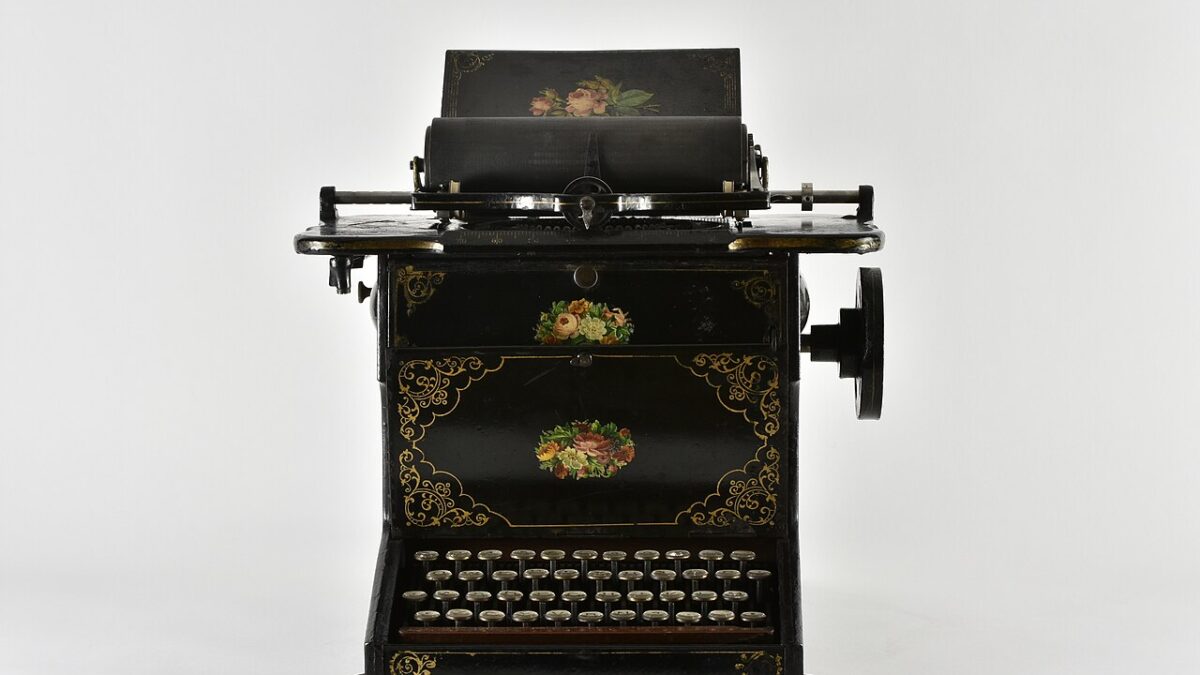
It was 1873, and Christopher Latham Sholes had a problem: his typewriter kept jamming. Type two adjacent letters too quickly on his early prototype — the metal arms swinging up to strike the page — and they’d collide mid-air and lock together, forcing the typist to reach in and pry them apart by hand. Sholes’ fix for this wasn’t elegant. It was ruthless. He looked at which letter pairs jammed most often in English and physically tore them apart on the keyboard, scattering common combinations to opposite corners so the metal arms would never approach from the same direction at the same time. The layout that fix produced is the one your thumbs are resting near right now.
The Myth, and Why It’s Only Half True
You’ve probably heard the QWERTY origin story told as a single, tidy sentence: it was designed to slow typists down so the machine wouldn’t jam. That’s not quite right, and the actual history is more interesting than the myth. Sholes wasn’t trying to make anyone slower — he was trying to keep the machine physically functional. Separating high-frequency letter pairs was a mechanical necessity, not a deliberate speed penalty. The slowdown, if there was one, was a side effect nobody was optimizing for.
Even that “corrected” version isn’t the whole story. A competing theory from Japanese historian Koichi Yasuoka — taken seriously enough to get real estate in Smithsonian Magazine’s coverage of the topic — argues the layout was also shaped by telegraph operators, who were among the earliest professional typists and needed certain letters positioned for transcribing Morse code quickly and accurately. If that’s right, the tidy “it was just about jamming” narrative that replaced the original myth is itself a slight oversimplification. The honest version is: nobody fully agrees on the whole reason, 150 years later.
Remington Made It Permanent
Sholes didn’t have the manufacturing muscle to make his layout the default — that took Remington. The Sholes & Glidden typewriter was patented in 1878, and Remington put QWERTY on every model that followed, starting with the Remington 2. That’s the moment the layout stopped being one inventor’s mechanical workaround and became an industry standard. Typing schools sprang up teaching QWERTY specifically. Offices bought Remington machines because their new hires had already learned the layout. Once that loop closed, no competing layout was ever going to unseat it purely on merit — and something close to that experiment actually got run, decades later.
The Dvorak Challenge — and the Study That Wasn’t What It Claimed
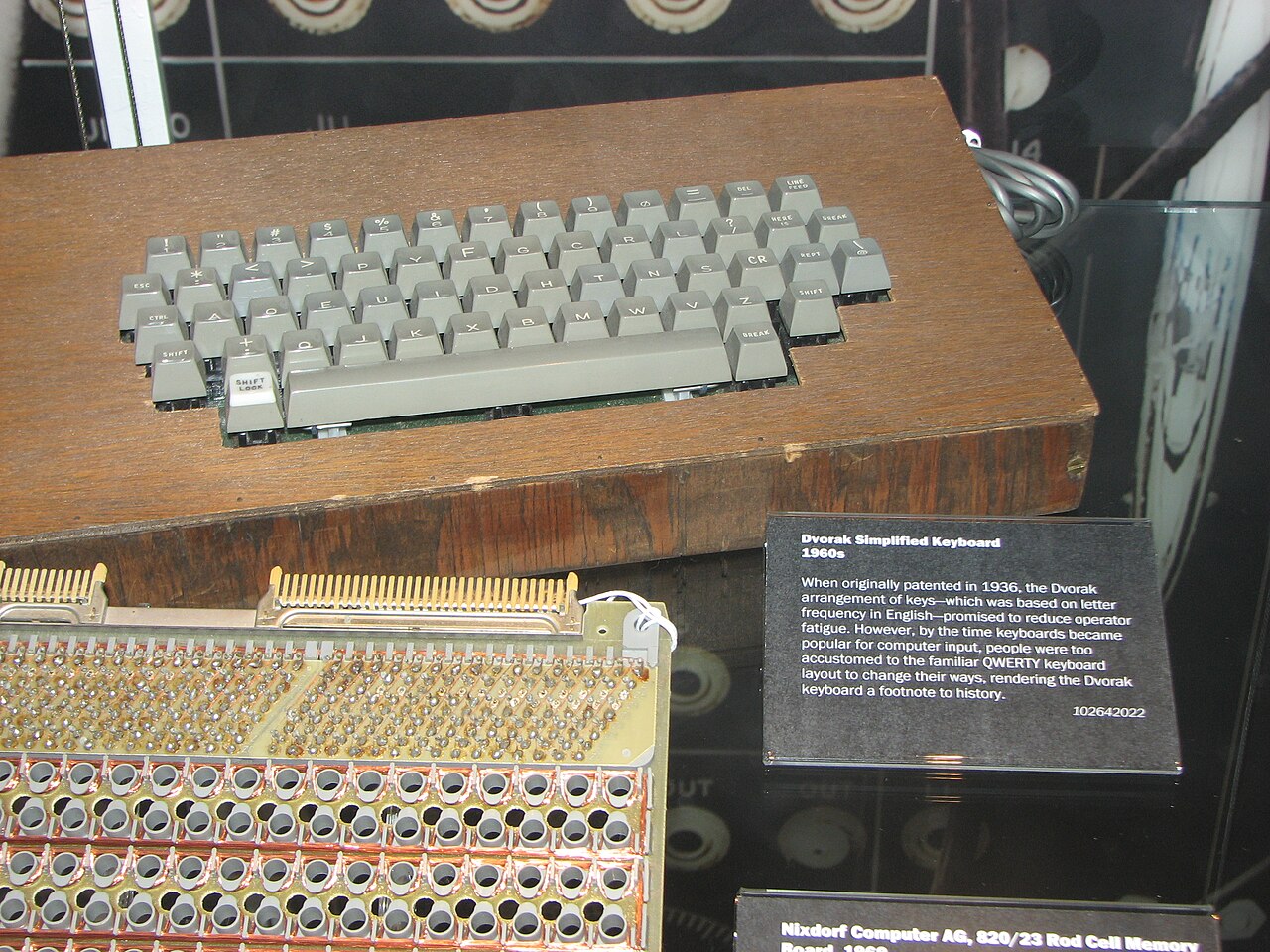
In the 1930s, Lieutenant Commander August Dvorak designed a new layout that put the most commonly used letters on the home row, theoretically reducing finger travel and boosting speed. In 1944, a U.S. Navy study claimed Dvorak typists were 74-75% faster than QWERTY typists — a number that, if true, should have ended the QWERTY era on the spot.
It didn’t, and there’s a reason it didn’t hold up. That 1944 study was conducted by August Dvorak himself — the same man who held the patent on the layout and stood to benefit financially from its adoption. Later scrutiny found real methodological problems, including inconsistent tester age and skill level between the QWERTY and Dvorak groups. When the U.S. General Services Administration commissioned a follow-up study under Earle Strong, it failed to replicate Dvorak’s results at all, and attributed the original numbers to experimenter bias. Later controlled studies were even less flattering to the Dvorak case: one 1973 study found only a 2.6% speed gain after a punishing 104 hours of retraining, and a 1978 study found typists still hadn’t recovered their original QWERTY speed after 100 hours on Dvorak. The layout wasn’t proven superior. It was proven to have a very motivated inventor.
How This Shapes What You Buy Today
Here’s the part that actually matters for anyone shopping for a keyboard in 2026: layout stopped being the differentiator decades ago. QWERTY won the standardization war so completely that even Gboard and SwiftKey — swipe-typing keyboards built for a completely different input method than discrete keystrokes — still default to a QWERTY key arrangement on your phone screen. There was no mechanical reason left to keep it once typewriters disappeared. It stuck anyway, purely on muscle memory and switching cost, the same forces that locked it in back in 1878.
What actually separates a good typing experience now isn’t the letter arrangement — it’s the switch mechanism, key travel, and how well the software behind it predicts what you’re trying to type. If you’re chasing a better typing feel, that’s the section of the spec sheet worth your attention, not layout wars that were functionally settled before your grandparents were typing.
QWERTY Was the Original Standards War
Tech history loves to talk about VHS beating Betamax, or how a “worse” format won because it locked in distribution and habit before the “better” one could compete. QWERTY vs. Dvorak is the same story, just a full century earlier and with a keyboard instead of a videotape. The pattern repeats because the underlying mechanism is the same every time: once enough people, schools, and manufacturers commit to a standard, the cost of switching — retraining muscle memory, replacing hardware, rewriting training materials — grows faster than any efficiency gain the alternative promises. Dvorak didn’t lose because it was worse. It lost because QWERTY had a 60-year head start locking in the infrastructure around it before Dvorak’s patent even existed.
The Layout That Refused to Die
QWERTY is now somewhere around 148 to 150 years old, depending on whether you date it to Sholes’ early prototypes or Remington’s 1878 patent. It has survived the complete disappearance of the mechanical problem it was built to solve, a well-funded and study-backed rival, and every input method humans have invented since — mice, trackpads, touchscreens, swipe gestures, even voice-to-text as a fallback when your thumbs give up. Every one of those technologies had a chance to reset the layout question from scratch. None of them did. That’s not really a story about typewriters anymore; it’s a story about how thoroughly a good-enough standard, once it locks in, can outlive every reason it existed in the first place.
Further reading: If the mechanics of what makes a keyboard actually feel good to type on is more your interest than the history, our guide to choosing the right mechanical keyboard switch covers exactly that. And if you’re the type of person who finds a 150-year-old design quirk genuinely fascinating, the collectors chasing rare and limited-run peripherals in our coverage of Razer’s sold-out anniversary mouse are chasing a version of the same instinct.
Deixe um comentário