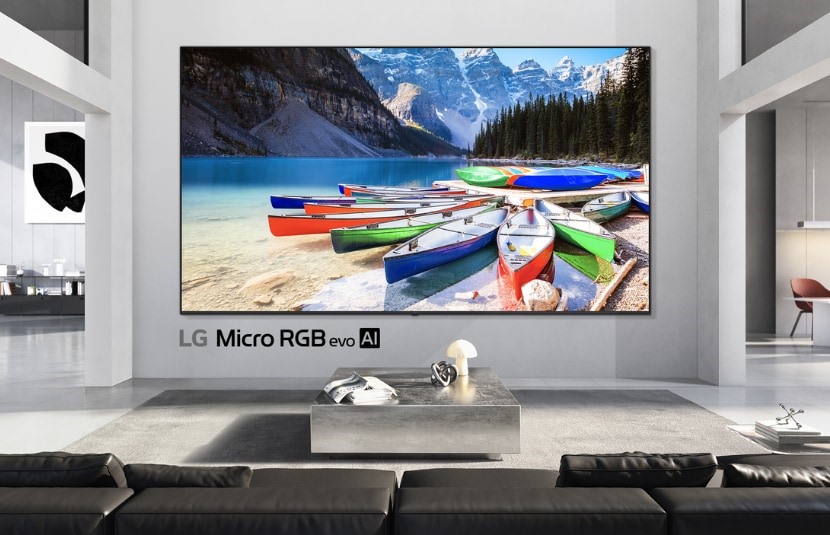
LG’s First Flagship RGB TV Costs $5,000 — Inside the Micro RGB evo
LG has put a hard number on its biggest TV bet in years, and pre-orders are live on LG.com right now for all three sizes. The LG Micro RGB evo TV price starts at $4,999.99, climbing to nearly $8,000 at the top end. This is LG’s first flagship RGB-backlit television — a genuinely different backlight architecture than the OLED and MiniLED sets you already know from the brand — and that starting price alone tells you LG isn’t pitching this as a mainstream upgrade.
Here’s why it matters beyond the sticker shock: LG has never shipped a TV in this backlight category before. Micro RGB evo (model MRGB95) is a new product line, not an iteration on an existing one, and it’s built to go toe-to-toe with RGB-backlit sets already landing from Hisense, Samsung, Sony, and TCL. The Micro RGB evo also won a CES 2026 Innovation Award before it ever reached pre-order pages — so the industry noticed before consumers could buy in.
LG Micro RGB evo TV Price and Availability
The pricing breaks down by size, and it climbs fast:
- 75-inch (75MRGB95BUA): $4,999.99
- 86-inch (86MRGB95BUA): $6,999.99
- 100-inch (100MRGB95BU): $7,999.99
All three sizes are available to pre-order on LG.com today, with select sizes also listed through Best Buy. There’s no Amazon.com listing yet — this is early enough in the rollout that the usual third-party retail channels haven’t caught up, so LG’s own site is your only pre-order path right now.
What Makes It “RGB”
Every TV backlight has to solve the same problem: how do you light up an LCD panel evenly without washing out contrast? Standard MiniLED TVs use a grid of white or blue LEDs behind a color filter or quantum-dot layer to produce color. The Micro RGB evo skips that middleman entirely — it uses individually controlled red, green, and blue LED elements as the backlight itself, driven by LG’s Micro RGB Engine across 8.3 million individual pixels.
That’s paired with the Alpha 11 AI Processor Gen 3, the same chip family LG uses in its OLED lineup, running “Micro Dimming Ultra” — LG’s term for orchestrating more than 1,000 local dimming zones with pixel-level precision. In plain terms: instead of one light source trying to fake a full-color image, you’ve got three colored light sources doing the actual color work directly, with AI processing deciding how to balance them scene by scene.
The Color Numbers
LG isn’t just claiming better color here — it got the claim certified. The Micro RGB evo has earned Intertek’s Triple 100% Color Coverage certification, meaning it hits full gamut coverage across three separate standards: BT.2020, DCI-P3, and Adobe RGB. Most TVs, even good ones, land well short of BT.2020 full coverage. Getting all three certified on one panel is a legitimately rare claim, and it’s the number LG is leaning on to justify the price gap over its own OLED sets.
The set also runs webOS 26 with Voice ID and Google Gemini integration, plus support for Dolby Vision and Dolby Atmos — so the smart-TV side of the experience is standard current-generation LG, not a stripped-down showcase unit.
Micro RGB evo vs OLED — Should You Wait?
Here’s the honest tension nobody at LG is hiding: this isn’t a straight upgrade over OLED, it’s a trade-off. RGB backlighting can push brighter peak output than OLED and holds up better in sunlit rooms, which is exactly why LG is marketing it toward buyers who want a big screen in a bright living room rather than a dark home theater. LG itself has acknowledged the catch — RGB backlighting is prone to color bleed from crosstalk and blooming around bright objects on dark backgrounds, the kind of artifact OLED’s self-emissive pixels simply don’t have. Nobody has resolved whether Triple 100% Color Coverage alone is worth giving up OLED’s true blacks and contrast — that’s still an open question industry-wide.
If you’re trying to figure out where Micro RGB fits next to the panel types you already know, our OLED vs QLED vs Mini-LED breakdown lays out exactly how backlight architecture changes what you see on screen — read that first if the terminology above felt like a lot.
Who This TV Is Actually For
At $5,000 to $8,000, the Micro RGB evo isn’t competing for your next TV purchase — it’s competing for LG’s halo-product slot, the one that proves the tech works before it trickles down to affordable sizes in a year or two. If you’ve got a bright room, a 75-inch-plus wall to fill, and a budget that doesn’t blink at flagship pricing, it’s a legitimate option. Everyone else should sit this generation out.
That’s not a knock on wanting a great TV without the flagship tax — we’ve been skeptical of chasing every new spec number before, and our breakdown of why 8K TVs aren’t worth the hype covers the same instinct to pump the brakes on marketing-driven upgrades. And if $5,000 was never in your budget to begin with, our picks for the best TVs under $500 prove you don’t need RGB backlighting to get a genuinely good picture.
LG’s own official press release has the full spec sheet if you want to dig deeper before pre-ordering.
Deixe um comentário