It was the summer of 1984, and a 28-year-old researcher at the Soviet Academy of Sciences had a problem: he wanted to test a new machine, and the only tool he had to test it with was his imagination. Alexey Pajitnov wasn’t trying to build the best-selling video game of all time. He was trying to see what the Electronika 60 — a boxy, graphics-less clone of the American PDP-11 — could actually do with a puzzle made of falling shapes.
It Was 1984, and a Soviet Programmer Had a Problem
The Electronika 60 had no real graphics chip, so Pajitnov’s first version of Tetris ran on bracket characters instead of blocks — literal punctuation marks tumbling down a monochrome screen. He drew the shapes from pentominoes, a classic puzzle piece made of five squares, but quickly realized five was too many to track visually. He dropped it to four. The name followed the same logic: “tetra,” Greek for four, fused with “tennis,” Pajitnov’s favorite sport. There was no design document, no publisher, no plan. A colleague, Vadim Gerasimov, ported the game to the IBM PC shortly after, replacing the bracket characters with actual colored blocks — and that’s the version that started leaking out of Soviet research institutes on floppy disks, employee to employee, with no commercial release in sight.
That’s the part most people get wrong about Tetris: it wasn’t built to be sold. It spread the way a rumor spreads — because it was good, not because anyone marketed it.

How Tetris Escaped the USSR (the Licensing War)
Getting Tetris out of the Soviet Union legally turned out to be far harder than writing it. All rights belonged to ELORG (Elektronorgtechnica), the state agency that handled every software export from the USSR — which meant no Western company could simply “buy” Tetris from Pajitnov. They had to negotiate with a government office.
Mirrorsoft, Spectrum Holobyte, and the Tangle of Rights Claims
In 1988, a British entrepreneur named Robert Stein struck a deal through his company Andromeda with ELORG for worldwide rights to Tetris — but the contract, as written, covered “computers” only. Stein’s partners, Mirrorsoft in the UK and Spectrum Holobyte in the US, published the PC and Amiga versions under that license. The trouble started when Mirrorsoft sublicensed arcade rights to Tengen, a subsidiary of Atari Games, without ELORG’s sign-off on that specific use. Tengen ran with it anyway, shipping an unlicensed Tetris cartridge for the Nintendo Entertainment System on May 17, 1989. It sold roughly 150,000 copies before anyone in Moscow noticed the contract had been stretched past what it actually said.
Henk Rogers’ Trip to Moscow and the ELORG Deal
Enter Henk Rogers, a Dutch-American game designer running a small Japanese publisher called Bullet-Proof Software. Rogers had licensed Tetris for Japanese computers and wanted the console and handheld rights nobody else had properly secured. On February 21, 1989, he got a meeting with ELORG’s Nikolay Belikov — and came away with the sense that the agency was already unhappy with how Mirrorsoft’s sublicense had spiraled. Rogers brought that intel straight to Nintendo of America president Minoru Arakawa. Three weeks later, on March 15, 1989, Rogers, Arakawa, and Nintendo VP Howard Lincoln flew to Moscow together and negotiated directly with ELORG for the handheld and console rights — a deal that would define the next decade of portable gaming. When the dust settled, a US court sided with Nintendo in the resulting Nintendo v. Atari Games (Tengen) case, and Tengen’s unlicensed NES cartridges were pulled from shelves.
It’s a genuinely wild story — Cold War bureaucracy, a Soviet state monopoly, and a scramble between three Western companies for the rights to a puzzle game — and it’s close enough to the truth that when Apple TV+ turned it into a 2023 thriller starring Taron Egerton as Rogers, the cast openly said most of what’s on screen actually happened. The one invented scene, according to Egerton, is a car chase near the end.
The Game Boy Bet That Changed Everything
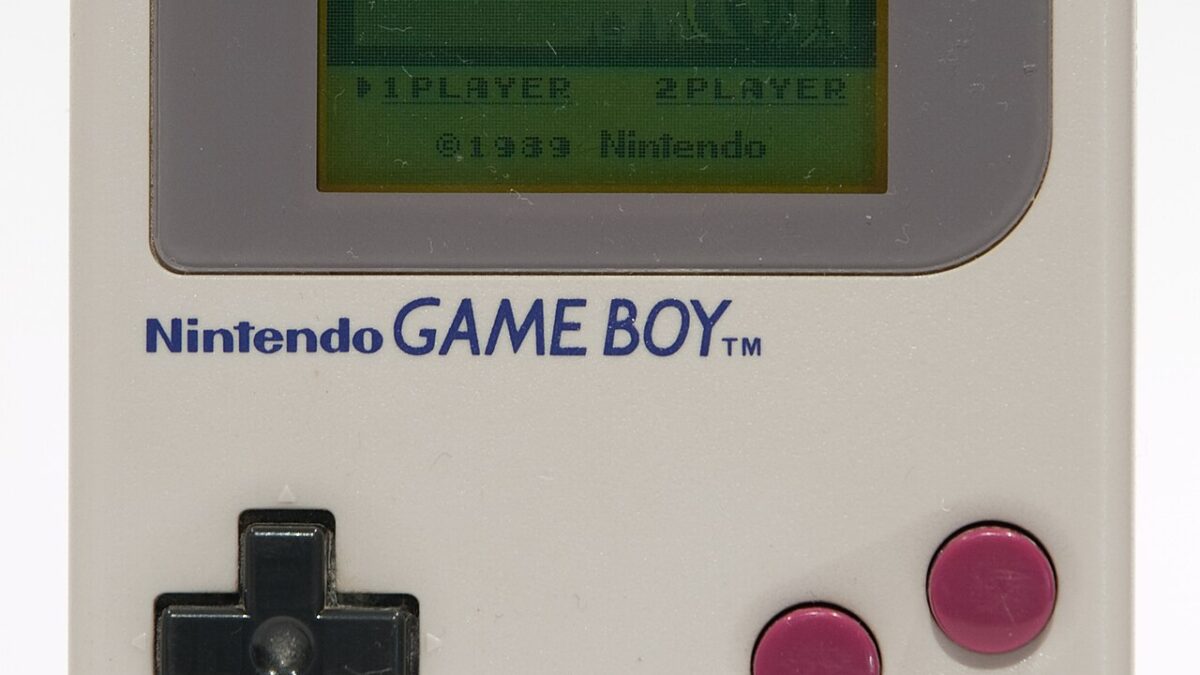
Nintendo didn’t just want Tetris for a console — it wanted Tetris for the Game Boy, a handheld that hadn’t even launched yet and that most of the industry expected to lose to Atari’s flashier, color-screen Lynx. Nintendo made an unusual call: instead of bundling the Game Boy with a flagship platformer to show off its hardware, it packed in Tetris, a game that ran fine on the machine’s dim green-and-black LCD and didn’t need fast reflexes to be addictive.
The Game Boy launched in Japan on April 21, 1989, at ¥12,500, and the first shipment of 300,000 units sold out almost immediately. It reached the US on July 31, 1989, and moved a million units within weeks — with Tetris as the pack-in in North America and Europe. That single packaging decision is credited with over 35 million Tetris sales tied directly to the console, out of roughly 118.69 million Game Boy-family units sold between 1989 and 2003. Ask anyone who worked in games retail in the early ’90s and they’ll tell you the same thing: people weren’t buying a Game Boy to play Mario. They were buying it to play Tetris on the bus.
How This Shapes Puzzle Games Today
Every “one more try” mobile puzzle game — Candy Crush, 2048, Threes! — is working from a formula Tetris proved first: simple input, escalating difficulty, no explicit end state, and a scoring system that always makes you feel like the next run could be the good one. Tetris also normalized the idea that a portable device’s killer app didn’t need branding, mascots, or a story — it needed a loop good enough to survive a subway ride. That’s arguably a bigger legacy than the game itself: it set the template for what “pick-up-and-play” even means, decades before smartphones made the phrase a marketing cliché.
Tetris in 2026 — Still Everywhere
Forty-two years after Pajitnov’s first bracket-character prototype, Tetris hasn’t slowed down. The Classic Tetris World Championship remains a legitimate competitive scene — its 2025 edition in Pasadena saw returning champion Alex T defend the title without dropping a single match as the No. 1 seed, a feat no one had managed since Jonas Neubauer in 2011, making Alex T only the fourth multi-title champion in the tournament’s history. Modern versions like Tetris 99 (a 99-player battle royale spin on Nintendo Switch) and Tetris Effect: Connected keep the format alive for players who never touched an Electronika 60 and never will.
If competitive puzzle games and the handheld culture Tetris helped invent are your thing, we go deeper on where that culture lives today in our breakdown of the handheld retro boom Tetris helped start — it’s a straight line from a Game Boy pack-in to the retro handhelds selling out in 2026. We’ve also covered gaming anniversary hardware in the same nostalgia-meets-commerce vein, and if you want to see what “portable gaming” looks like on the other end of the spectrum today, our look at today’s handheld gaming PCs picks up almost exactly where the Game Boy left off.
Further reading: Tetris’s 1989 Game Boy pairing remains one of the cleanest case studies in gaming history of how a launch bundle — not raw hardware specs — can decide a console war.
Deixe um comentário