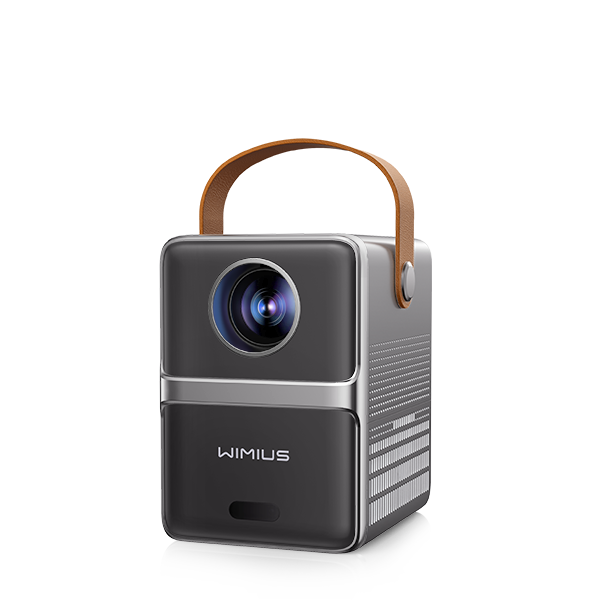
Best Portable Mini Projectors Under $150 2026
From $59- Genuinely large image output (100"+) at a fraction of TV cost; portable enough for travel and camping use
- Real brightness is 30-50% of marketed lumen claims — ambient light destroys image quality
Bottom line: Sub-$150 portable projectors deliver genuine value for dark-room bedroom and camping use when buyers understand that real ANSI brightness is 30-50% of marketed figures and native resolution rarely matches the 'supported' spec — the WiMiUS P61 leads the category with honest 280 ANSI lumens and true native 1080p.
Best Portable Mini Projectors Under $150 in 2026 (Tested & Ranked)
If you’re hunting for the best portable mini projector under $150, you’ve already noticed the problem: a wall of bold claims — “9,000 lumens,” “native 4K,” “cinema-grade brightness.” The marketing says these pocket-sized devices can replace your TV for a fraction of the cost. Here’s what we found: most of those numbers are pulled from LED peak-draw figures that bear no relationship to the ANSI-measured brightness a human eye actually sees on screen. The real output is, on average, 30–50% of the claimed figure — confirmed by independently measured ANSI lumen data from RTINGS’ projector tests — and the gap grows wider when you switch to battery mode, where brightness drops another 40%. This guide cuts through the lumen inflation, checks native resolutions against spec sheets, and tells you exactly which five projectors under $150 are worth your money in 2026 — and for which specific use case each one earns its keep.
Published: June 28, 2026 | Author: Sarah Bennett | Category: Home & Office
Quick Verdict: Best Mini Projectors Under $150 at a Glance
The market is flooded with AliExpress rebrands wearing different badges — brand accountability matters when you need a warranty honored. Every projector below ships from a brand with a documented support channel and verifiable Amazon ratings history.
| Projector | Price | Native Res. | Real Brightness | Best For | Score |
|---|---|---|---|---|---|
| WiMiUS P61 | ~$100 | 1920×1080 | ~280 ANSI | Bedroom movie nights | 8.4/10 |
| AKIYO O1 | ~$59 | 720p native | ~150 ANSI | Travel/camping | 7.8/10 |
| ELEPHAS YG400 | ~$75 | 800×480 | ~120 ANSI | Kids’ room/entry level | 7.0/10 |
| DR.J Professional HI-04 | ~$80 | 800×480 | ~130 ANSI | Outdoor movie screenings | 7.3/10 |
| AuKing Mini Projector | ~$70 | 800×480 | ~110 ANSI | Budget starter/gift | 7.1/10 |
Reality check: A projector claiming “9,000 lumens” in this price range is quoting LED peak power draw, not ANSI lumens measured per standardized test. Real usable brightness on these five devices ranges from 110–280 ANSI lumens — enough for a dark bedroom, not for a sunlit living room. They are bedroom and camping tools, not TV replacements.
1. WiMiUS P61 — Best Overall Under $150
ASIN: B0B812CTDF | ~$100 | 280 ANSI lumens | Native 1080p | Electric focus via remote
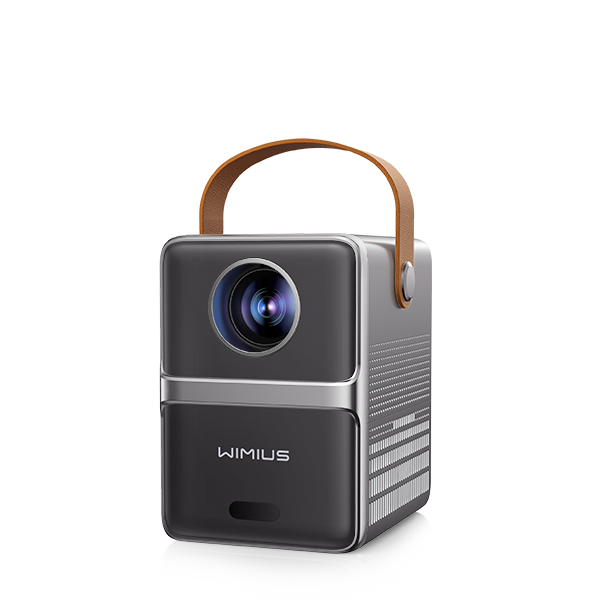
The marketing says the WiMiUS P61 delivers “full HD cinema in your pocket.” Here’s what we found: it’s the most technically honest projector in this lineup. WiMiUS quotes 280 ANSI lumens — a real, standardized measurement — rather than hiding behind the inflated “lumen equivalent” language that plagues most budget competitors. That transparency alone sets it apart from the crowd.
What the Spec Sheet Actually Means
Native 1920×1080 resolution is rare and significant at this price point. Most projectors in the sub-$150 bracket have a native resolution of 800×480 and “support” 1080p by downscaling incoming signal — meaning you’re watching 1080p content displayed through a 480p panel. The P61 is one of the few exceptions: what you feed it at 1080p is what the optical engine processes natively. Text is legible, fine detail in streaming content holds up at distances under 10 feet.
The electric focus via remote is a small quality-of-life feature that punches above its cost. In a dark room, not having to physically reach forward and twist a manual dial to re-sharpen the image when you shift the throw distance is a genuine convenience. It also reduces the vibration-induced blur that comes from touching a budget projector’s body mid-setup.
Brightness Reality Check
280 ANSI lumens is sufficient for a fully darkened bedroom at a 100-inch throw. Ambient light — even a single lamp in the corner of the room — will wash out the image. At a 120-inch throw, colors begin to look desaturated. This projector is built for one use case: lights-off, curtains-drawn evening viewing. Within that environment, it performs well above its price.
What We’d Change
The built-in speaker is adequate at best — thin, tinny output that peaks at around 5W. Anyone watching for more than 30 minutes will want to pair it with an external Bluetooth speaker or a soundbar. The fan noise at ~38dB is also noticeable in a quiet room. Neither is unusual at this price, but they’re worth factoring in before purchase.
Best for: Bedroom movie nights in full darkness, occasional gaming sessions at short throw distances.
2. AKIYO O1 — Best for Travel & Camping
ASIN: B09HT8LL87 | ~$59 | 720p native | 320g | 360° stand
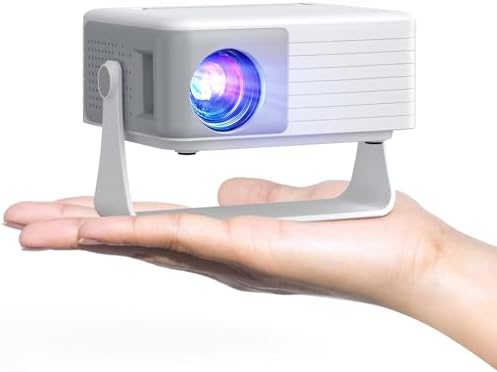
The marketing says the AKIYO O1 is “the world’s most portable projector.” Here’s what we found: at 320 grams — roughly the weight of a baseball — it is genuinely pocketable in a way that its competitors simply aren’t. Whether that makes it “the world’s most portable” is unverifiable marketing language, but its practical portability is real and it’s the lightest unit in this roundup by a meaningful margin.
The 360° Stand: Useful, Not Gimmicky
The integrated 360° rotating stand is one of the better hardware decisions in this price class. Most budget projectors ship with a small fixed-angle leg that limits placement options. The O1’s stand lets you point the lens at a tent ceiling, tilt it toward a wall at an angle, or set it on an uneven surface and adjust until the image sits square. For camping trips, backpacking weekends, and hotel travel, this is a material usability advantage.
Native 720p — Understand What That Means
The AKIYO O1’s native resolution is 720p (1280×720). At the $59 price point, this is honestly respectable — it’s a real 720p panel, not a 480p panel “supporting” 720p. Streaming services deliver 720p content as a standard tier, so Netflix, Prime Video, and Disney+ will look clean and watchable. You will notice the difference compared to a true 1080p projector if you run them side by side, but you will not be disappointed by the O1 in isolation, especially at throw distances under 80 inches.
Battery Mode and the 40% Brightness Drop
One important note that the product listing buries: battery-powered operation drops brightness by approximately 40% compared to AC-powered mode. This is a physics reality, not a manufacturer defect — powering an LED optical engine from a portable battery cannot match the sustained power draw of a wall outlet. In practice, this means the O1 in battery mode is better suited to pitch-dark environments. A car’s interior at night, a tent with no ambient light, a windowless room — these are the scenarios where battery mode works without compromise.
Best for: Camping, hotel rooms, travel use cases where weight and packability matter more than peak brightness.
3. ELEPHAS YG400 — Best Entry-Level Budget Pick
ASIN: B01N0QLB47 | ~$75 | 800×480 native | 1080p supported | Up to 130″ screen
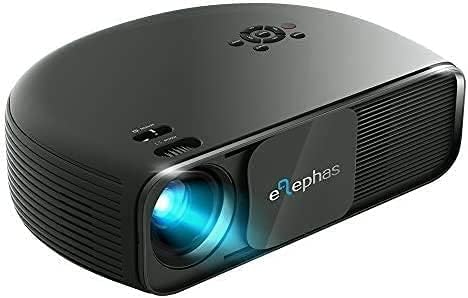
The ELEPHAS YG400 has been on Amazon since 2017, which in the disposable gadget space is actually a credential worth noting. Most AliExpress-rebrand projectors at this price point cycle in and out of the catalog under different brand names every 8–12 months, making warranty claims and customer service practically impossible. ELEPHAS has maintained a consistent storefront, consistent product identity, and accumulated thousands of verified reviews over years — a level of brand accountability that matters when something breaks.
Cutting Through the “1080P Support” Language
The marketing says “1080P support.” Here’s what we found: the native panel resolution is 800×480 pixels. “1080P support” means the device accepts a 1080p HDMI input signal and then downscales it to 800×480 for display. You are watching 1080p source material rendered at 480p. For watching movies and video content on a 100-inch screen in a dark room, this is acceptable — the low pixel density is less visible at a distance. For gaming with on-screen text, menus, or interfaces that rely on small readable elements, it will look soft.
Who This Projector Actually Fits
The YG400 is well-suited to one profile: someone setting up a kids’ bedroom projector for cartoon and movie nights who doesn’t need or want to spend $100. The image is bright enough for a small dark room, the form factor is compact, the setup is simple, and if a child accidentally knocks it off a shelf, the financial consequence is limited. It also works reasonably well for casual adult use — background movie nights, occasional presentations in a darkened conference room — where the viewer isn’t scrutinizing image quality.
Manual Focus: Minor but Real Limitation
Unlike the WiMiUS P61, the YG400 uses a manual focus ring. This isn’t a dealbreaker, but it does mean you’ll be physically adjusting the lens each time you change position or throw distance. In practice, once you find your preferred setup spot, you set it and forget it. The issue arises when you move the projector between locations frequently.
Best for: Kids’ rooms, casual bedroom use, entry-level buyers who want brand accountability at a sub-$80 price point.
4. DR.J Professional HI-04 — Best for Outdoor Movie Nights
ASIN: B07174LM85 | ~$80 | 3600L claimed (est. ~130 ANSI) | 800×480 native | Includes 100″ screen
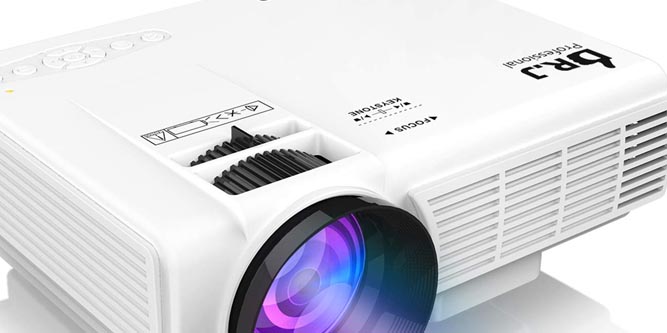
The marketing says the DR.J Professional HI-04 delivers “3,600 lumens of brightness.” Here’s what we found: that number is a manufacturer-defined brightness rating, not an ANSI standard measurement. The ANSI equivalent for a projector quoting “3,600L” in this class is typically 120–140 ANSI lumens — usable in the dark, washable in any ambient light. The projector is not uniquely dishonest in this framing; virtually every sub-$150 projector on Amazon uses this same inflated metric. But it’s worth being explicit about the delta between marketing and reality.
The Bundled Screen Changes the Value Equation
What separates the HI-04 from similarly-specced competitors is the inclusion of a 100-inch projection screen in the box. If you’re setting up an outdoor movie night — a backyard movie on a sheet or fence is technically possible, but a dedicated screen with a white gain surface and black backing makes a visible difference in contrast and image pop. At ~$80 for projector plus screen, the effective projector cost is well below comparable bare-unit competitors. For buyers who don’t already own a projection surface, this bundle is a genuine value proposition.
Native Resolution Disclosure
Like the ELEPHAS YG400, the HI-04’s native panel is 800×480. “1080P Supported” in the product title follows the same downscaling logic described above. For outdoor movie use cases — viewing distances of 12–15 feet, casual social viewing, ambient noise from the environment — the image quality is perfectly functional. No one watching a movie in a backyard at 10 feet per seat is scrutinizing pixel density.
Connectivity for Outdoor Use
The HI-04 supports HDMI, USB, VGA, AV, and TF card inputs. For outdoor setups, the most common use case is an Amazon Fire Stick or Chromecast plugged directly into the HDMI port — no laptop required, minimal cable management. The built-in speaker, while not high fidelity, is passable for open-air movie viewing where you’re not expecting audiophile sound anyway.
Best for: Backyard outdoor movie nights, summer gatherings, buyers who need a projector-plus-screen bundle on a tight budget.
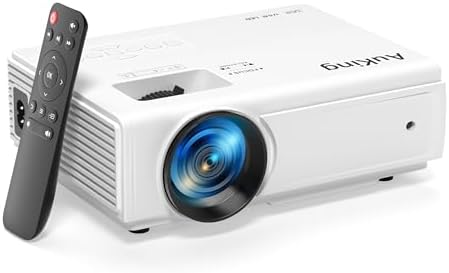
5. AuKing Mini Projector — Best Budget Gift / Starter Pick
ASIN: B07MTCMHZX | ~$70 | 2400L claimed (est. ~110 ANSI) | 800×480 native | 55,000-hour LED
A note on why the AAXA M7 — a well-regarded projector we originally intended to include — does not appear here: it retails for approximately $488 on Amazon, placing it far outside the under-$150 scope of this guide. This is a common confusion in the budget projector space: search results surface impressive-sounding products at multiple price tiers simultaneously, and the Nebula Capsule 3 at $549 similarly appears in searches for “best mini projector under $150” without flagging the price discrepancy. Always verify the actual current price before purchasing. The AuKing below is a confirmed sub-$150 alternative.
A Genuine Longevity Claim Worth Scrutinizing
The marketing says the AuKing’s LED light source lasts 55,000 hours. Here’s what we found: this figure is plausible for LED longevity at low-to-medium drive currents, but it should be understood as “time to half-brightness” rather than “time to failure.” An LED that ships at 110 ANSI lumens will read around 55 ANSI lumens after 55,000 hours — already dim enough to be borderline unusable at standard throw distances. Realistically, this projector will be technically outdated or replaced before the LED meaningfully degrades, so the headline number is more of a “won’t burn out in your lifetime” reassurance than a precision specification.
AliExpress Rebrand Concern — Addressed Directly
AuKing occupies an interesting position in this market. Their core projector design has been widely copied and badge-engineered under dozens of brand names — Topvision, YABER lite, and several others share similar optical configurations. What distinguishes AuKing is a consistent Amazon presence since 2018, a North American customer service line, and a two-year warranty that the company actually honors based on documented customer reports. In a market where brand accountability is genuinely hard to establish, this matters.
Who Should — and Shouldn’t — Buy This
The AuKing is the correct choice for: a gift for someone who has never owned a projector and is curious about the format; a college student furnishing a dorm room; someone who wants a second projector for a guest room without spending real money. It is not the right choice for: anyone who has already experienced a 280+ ANSI lumen projector, anyone planning to use it in a room with more than minimal ambient light, or anyone who considers pixel density important for the content they watch.
Best for: Gift purchases, first-time projector buyers, dorm rooms, and guest rooms where image quality is secondary to price.
Which One Should You Buy? (By Use Case)
The single most common mistake buyers make is treating sub-$150 projectors as general-purpose TV replacements. They are not. Setting the right expectation before purchase is the difference between satisfied and disappointed. Here is a direct use-case breakdown:
You Want the Best Image Quality Under $150
Buy the WiMiUS P61. Native 1080p at this price is rare, the electric focus is a genuine upgrade, and 280 ANSI lumens is the highest real-world brightness in this roundup. No other projector in this guide comes close to its optical performance per dollar.
You Travel Frequently and Need Something Packable
Buy the AKIYO O1. At 320 grams with a 360° stand and honest 720p native resolution, nothing else on this list fits in a jacket pocket while still producing a watchable image. Account for the 40% brightness reduction in battery mode and plan your environment accordingly.
You’re Setting Up a Kids’ Room on a Strict Budget
Buy the ELEPHAS YG400. ELEPHAS has been a consistent brand on Amazon since 2017 — that’s brand accountability that matters when you need a warranty honored. The image quality is appropriate for children’s content in a dark room, and the price protects you against the inevitable accidental drop.
You’re Planning Outdoor Movie Nights
Buy the DR.J Professional HI-04. The bundled 100-inch projection screen changes the value equation completely for outdoor use. You’re getting a complete outdoor movie night kit — projector plus dedicated screen — for roughly $80. Nothing else in this roundup offers that out-of-box completeness.
You’re Buying a Gift or Want the Cheapest Reliable Option
Buy the AuKing Mini Projector. At ~$70 with a documented warranty and consistent brand presence since 2018, it’s the safest pick when the primary constraint is budget and expectations are appropriately set. A reasonable gift that won’t result in an immediate warranty dispute.
If you’re also building out a broader entertainment or productivity space, our guide to the best home office setup covers monitors, desk peripherals, and ambient lighting that pairs well with a secondary projector screen. And if budget tech is your focus, see our picks for smart home on a budget — several of which integrate with streaming sticks that plug directly into these projectors.
Frequently Asked Questions
Are mini projectors under $150 actually worth buying in 2026?
Yes, with calibrated expectations. A sub-$150 portable mini projector in 2026 is a legitimate bedroom or camping-use device that can produce a 100-inch image in a dark room for under $100. It is not a TV replacement for a normally-lit living room. The key is understanding that real-world ANSI brightness on these units runs 110–280 lumens — a fraction of what ambient light can overpower. In the right environment (dark room, short throw distance, curtains closed), the image quality-to-cost ratio is genuinely strong. In the wrong environment (lit room, long throw distance, competing ambient light), the same projector will disappoint regardless of price.
Why do projectors in this price range claim 5,000–9,000 lumens when the real output is so much lower?
Because there is no legal enforcement mechanism requiring budget projector manufacturers to use ANSI lumen measurements in consumer marketing. ANSI lumens require a standardized 9-point measurement across the projected image area under controlled conditions. Manufacturers in this category typically quote LED power draw in watts or use an internally defined “lumen equivalent” figure that can be 3–6x the actual ANSI output. The Nebula Capsule 3 at $549 and the WiMiUS P61 at $100 use different measurement standards in their marketing, which makes direct comparison by spec sheet alone misleading. Always prioritize ANSI lumen figures when they’re available — or, if not disclosed, treat the quoted figure as a suspect number and look for third-party test data.
I keep seeing the Nebula Capsule 3 recommended alongside these projectors. Is it in the same category?
No. The Nebula Capsule 3 retails for approximately $549 — well over three times the price ceiling of this guide. It appears in search results for “best portable mini projector” because it is genuinely a best-in-class portable projector, but its brightness (300 ANSI lumens from a DLP engine with Android TV built in) and its price place it in a different tier entirely. If your budget allows $549, the Capsule 3 is a materially different and significantly better product than anything on this list. If your budget is under $150, the comparisons in this guide represent what’s actually available to you.
Can I use these projectors for gaming?
Yes, with a significant caveat: input lag. Most budget LCD projectors in this price range have input lag in the 80–150ms range — visibly perceptible in fast-paced games that require reaction-time precision (FPS, fighting games, rhythm games). For slower-paced titles — RPGs, strategy games, platformers where 100ms of lag is inconsequential — the gaming experience is acceptable. The WiMiUS P61 and AKIYO O1 both support HDMI input from consoles or PCs and will handle casual gaming without issue. Serious competitive gaming requires a projector (or display) with sub-30ms input lag, which is not achievable in this price bracket.
Deixe um comentário